

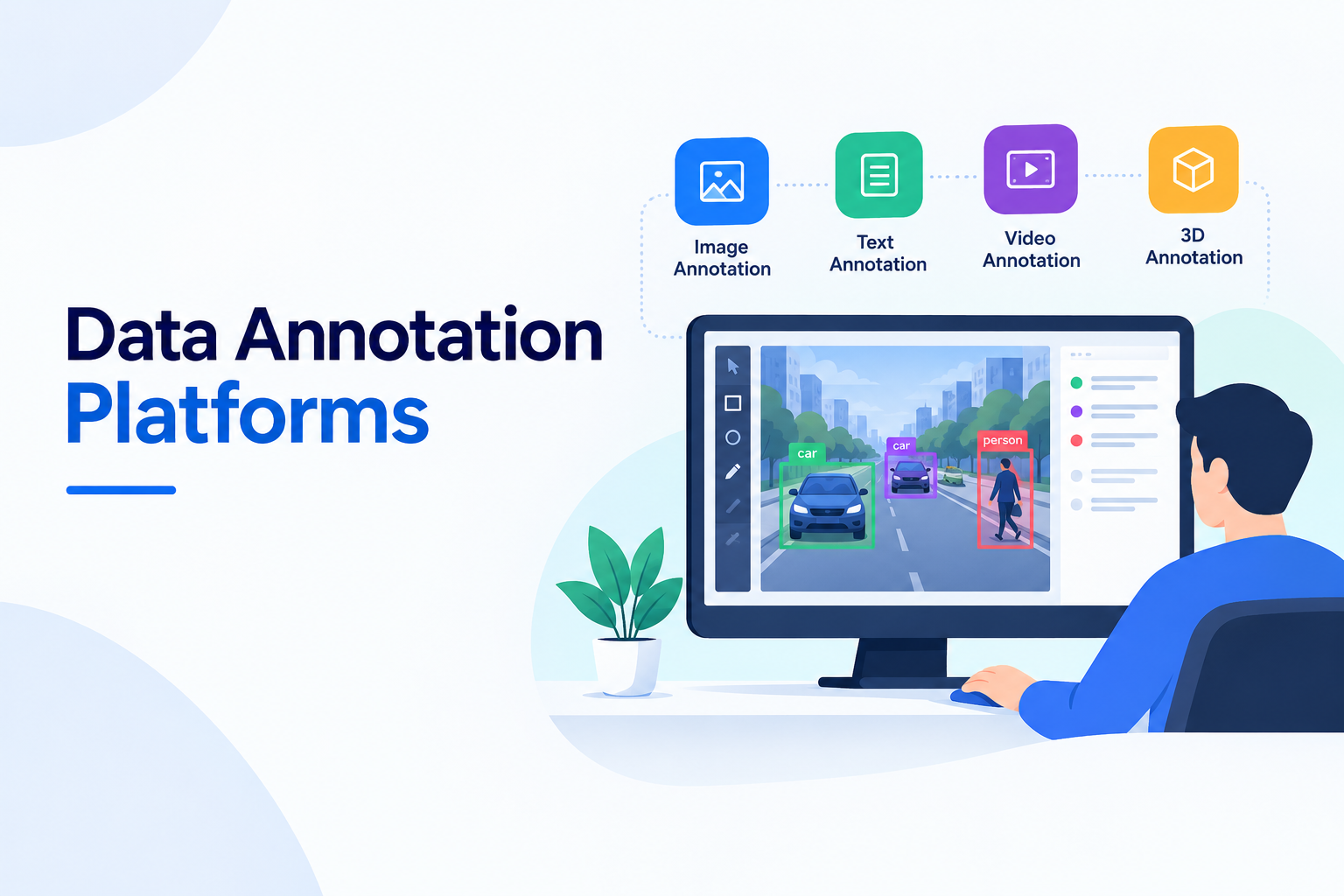

Artificial intelligence is entering a new phase in which the quality, ownership, and accessibility of data are becoming just as important as model architecture. Large language models, AI agents, computer vision systems, and autonomous applications all depend on massive volumes of accurately labeled information. As Web3 and artificial intelligence increasingly converge, developers need specialized datasets that can represent blockchain transactions, smart contracts, decentralized applications, digital assets, community activity, and other on-chain information.
This growing demand has created an emerging category known as decentralized data annotation platforms. Instead of relying entirely on centralized data-labeling companies, these platforms use distributed contributor networks, blockchain infrastructure, token incentives, staking, reputation systems, and transparent validation mechanisms to create training datasets.
Traditional annotation usually involves a company assigning labeling tasks to a centralized workforce. A decentralized approach can distribute these tasks across a global community while using technological and economic mechanisms to improve accountability. Blockchain can also provide data provenance, transparent reward settlement, and a verifiable record of contributions.
For Web3 AI developers, this model is particularly interesting. AI systems designed for blockchain environments may need to understand smart-contract behavior, transaction patterns, crypto terminology, governance discussions, wallet activity, market information, and other specialized datasets. Generic training data is not always sufficient for these applications.
Several projects are now attempting to solve this problem from different angles. Some focus on broad multimodal data, while others emphasize decentralized AI infrastructure, tokenized datasets, on-chain labeling, or Web3-specific information.
In this guide, we explore five notable decentralized data annotation platforms: PublicAI, Sahara AI, Pundi AI, LabelData, and ChainLabel. We will examine their approaches, potential use cases, strengths, and the factors developers should consider before selecting a platform.
What Are Decentralized Data Annotation Platforms?
Decentralized data annotation platforms are systems that distribute the process of collecting, labeling, reviewing, and validating AI training data across a network of contributors rather than depending exclusively on one centralized organization.
Data annotation itself is the process of adding meaningful labels to raw information. For example, an image can be labeled according to objects it contains, text can be classified by topic or sentiment, audio can be transcribed, and smart-contract information can be categorized according to its functions.
In a decentralized environment, contributors may complete these tasks through a marketplace or protocol. Blockchain technology can then be used to record contributions, manage incentives, establish reputation, or support transparent payments.
The concept is especially relevant to Web3 AI models because blockchain ecosystems produce highly specialized information. An AI agent designed to analyze decentralized finance, for example, may need datasets containing labeled transaction patterns, protocol interactions, governance proposals, and smart-contract activity.
Decentralized systems can potentially bring together contributors with different areas of expertise. This is important because high-quality annotation often requires more than simply identifying information. Specialized datasets may require people who understand finance, programming, blockchain technology, law, science, or particular industries.
Why Web3 AI Needs Better Training Data
The relationship between AI and Web3 is expanding rapidly. AI agents can analyze blockchain information, interact with decentralized applications, assist developers, summarize governance discussions, and support data-driven decision-making.
However, these applications require high-quality information. Poorly labeled datasets can introduce errors into AI systems, while incomplete datasets can cause models to miss important patterns.
For example, an AI model trained to understand smart contracts needs to distinguish between different functions, contract structures, events, permissions, and potential behaviors. Similarly, an AI system analyzing blockchain transactions needs context around addresses, transfers, protocols, and transaction types.
This makes AI training data, human annotation, data labeling, and dataset quality essential components of the Web3 AI ecosystem.
Decentralized data networks may offer another advantage: global participation. Instead of restricting annotation work to a relatively small centralized workforce, distributed platforms can potentially involve contributors from different regions and professional backgrounds.
5 Best Decentralized Data Annotation Platforms
1. PublicAI: Best for Multimodal Decentralized Data
PublicAI is one of the most prominent projects in the emerging decentralized AI data infrastructure sector. The platform describes itself as a decentralized network for collecting and annotating multimodal data, including text, audio, video, mapping information, and other datasets.
Its approach combines human contributors with AI-assisted workflows and validation mechanisms. According to PublicAI, its network includes millions of workers and hundreds of thousands of validators, while its Data Hub enables contributors to participate in dataset validation and earn rewards.
One of PublicAI’s notable features is its focus on quality control. The platform says it uses access tests, skill validation, staking mechanisms, and validator systems to improve the reliability of submitted data. This is important because simply decentralizing annotation does not automatically guarantee accurate results.
PublicAI also supports different types of annotation. Its current platform information lists capabilities including general image annotation, semantic segmentation, text collection, document transcription, named entity recognition, video annotation, and LiDAR-related annotation.
For Web3 AI developers, this broad multimodal approach can be useful when building systems that need more than blockchain text. AI agents increasingly interact with users through multiple data formats, meaning datasets may include text, audio, images, and video.
Another interesting component is PublicAI Data Hub. Users can upload datasets and participate in validation activities, with consensus mechanisms used to determine rewards.
The platform has also explored privacy-preserving AI infrastructure. A partnership with Nexus has focused on confidential data contributions, verifiable computation, and privacy-preserving AI workflows.
Overall, PublicAI stands out for its broad approach to decentralized AI data, particularly for projects that require multimodal datasets and distributed human validation.
2. Sahara AI: Best for Decentralized AI Data Services
Sahara AI takes a broader approach to decentralized artificial intelligence by focusing on AI infrastructure, data contribution, and the economic rights surrounding AI assets.
Its model is particularly relevant to organizations that want to create AI systems while giving contributors a role in the data-production process. Instead of viewing data purely as an internal resource, decentralized AI networks attempt to create an ecosystem in which contributors can participate in producing and improving datasets.
For Web3 applications, this approach can be valuable because AI projects often require specialized information that is difficult to collect through conventional sources.
Data annotation can involve tasks such as categorization, evaluation, classification, and human review. When these processes are distributed across a network, projects can potentially access a larger pool of contributors.
The important factor is quality control. Decentralized AI platforms need mechanisms that identify inaccurate submissions and reward reliable contributors. Automated screening, machine-assisted review, peer validation, and human quality assurance can work together to create a more robust workflow.
Sahara AI is therefore worth considering for teams looking beyond a simple annotation marketplace and toward a broader decentralized AI data ecosystem.
3. Pundi AI: Best for Tokenized AI Data
Pundi AI represents another approach to the relationship between blockchain and artificial intelligence. Its ecosystem focuses on AI data and the ability to create, label, manage, and potentially monetize datasets within a decentralized environment.
The central idea behind tokenized data is that information can be treated as an asset with identifiable ownership and economic value. This concept can become increasingly important as AI companies require enormous quantities of specialized training information.
Traditional datasets can be difficult to track after they move between different organizations. Blockchain-based infrastructure can potentially create more transparent records around ownership, contributions, and transactions.
For Web3 AI training, this can be particularly interesting because blockchain-native applications already operate around concepts such as digital ownership, tokens, and programmable transactions.
Pundi AI’s broader model connects data labeling with a decentralized AI economy. The objective is not simply to label information but to create infrastructure through which data contributors and AI developers can interact.
The value of this approach will ultimately depend on dataset quality, adoption, accessibility, and the practical usefulness of the resulting data. Tokenization by itself does not make a dataset valuable. The underlying information still needs to be accurate, relevant, diverse, and properly documented.
For developers interested in tokenized datasets and blockchain-based data ownership, Pundi AI is therefore an important project to watch.
4. LabelData: Best for On-Chain Data Labeling
LabelData focuses directly on decentralized data labeling and describes itself as an on-chain AI data labeling and distillation protocol built on BNB Chain. Its infrastructure combines labeling, quality management, and data asset concepts.
One of its distinguishing characteristics is its multi-role workflow. Labelers, reviewers, and quality inspectors can participate in the data-production process, creating multiple layers of oversight.
The platform also emphasizes transparent records. According to its website, actions within the labeling process can be recorded on-chain, while rewards can be settled through blockchain infrastructure.
This can provide an important advantage for projects where data provenance matters. Developers may want to know where a dataset originated, who contributed to it, how it was reviewed, and how quality decisions were made.
LabelData also introduces the concept of Data NFTs. Instead of treating datasets simply as files stored on a server, the platform presents data as potentially transferable digital assets.
This concept could become significant if AI-generated economic activity continues to grow. As businesses increasingly compete for proprietary training data, verifiable ownership and licensing could become more important.
For Web3 developers seeking an explicitly blockchain-oriented approach to annotation, LabelData offers an interesting combination of on-chain labeling, quality scoring, and data ownership.
5. ChainLabel: Best for Web3-Specific Data
ChainLabel takes a more specialized direction by focusing on Web3-related data annotation. Rather than attempting to serve every possible AI training requirement, its concept is centered around creating structured datasets for blockchain-focused AI applications.
This specialization matters because Web3 data can be difficult for general-purpose annotation systems to understand. Smart contracts, decentralized applications, wallets, blockchain transactions, token mechanics, and governance systems all have their own terminology and structures.
An annotator unfamiliar with blockchain technology could easily misunderstand the meaning of a dataset. A platform designed specifically around Web3 can potentially address this problem by creating annotation workflows that reflect blockchain-native concepts.
ChainLabel’s approach also aligns with the growing development of AI agents for Web3. These agents may need structured information to reason about smart contracts, protocols, transactions, and decentralized ecosystems.
The platform’s community-oriented model is another important part of its concept. Decentralized projects can use contributors and governance mechanisms to build specialized datasets while creating economic incentives around participation.
For developers whose primary requirement is blockchain-specific training data rather than generic image or video annotation, ChainLabel represents a particularly targeted approach.
How Blockchain Can Improve AI Data Annotation
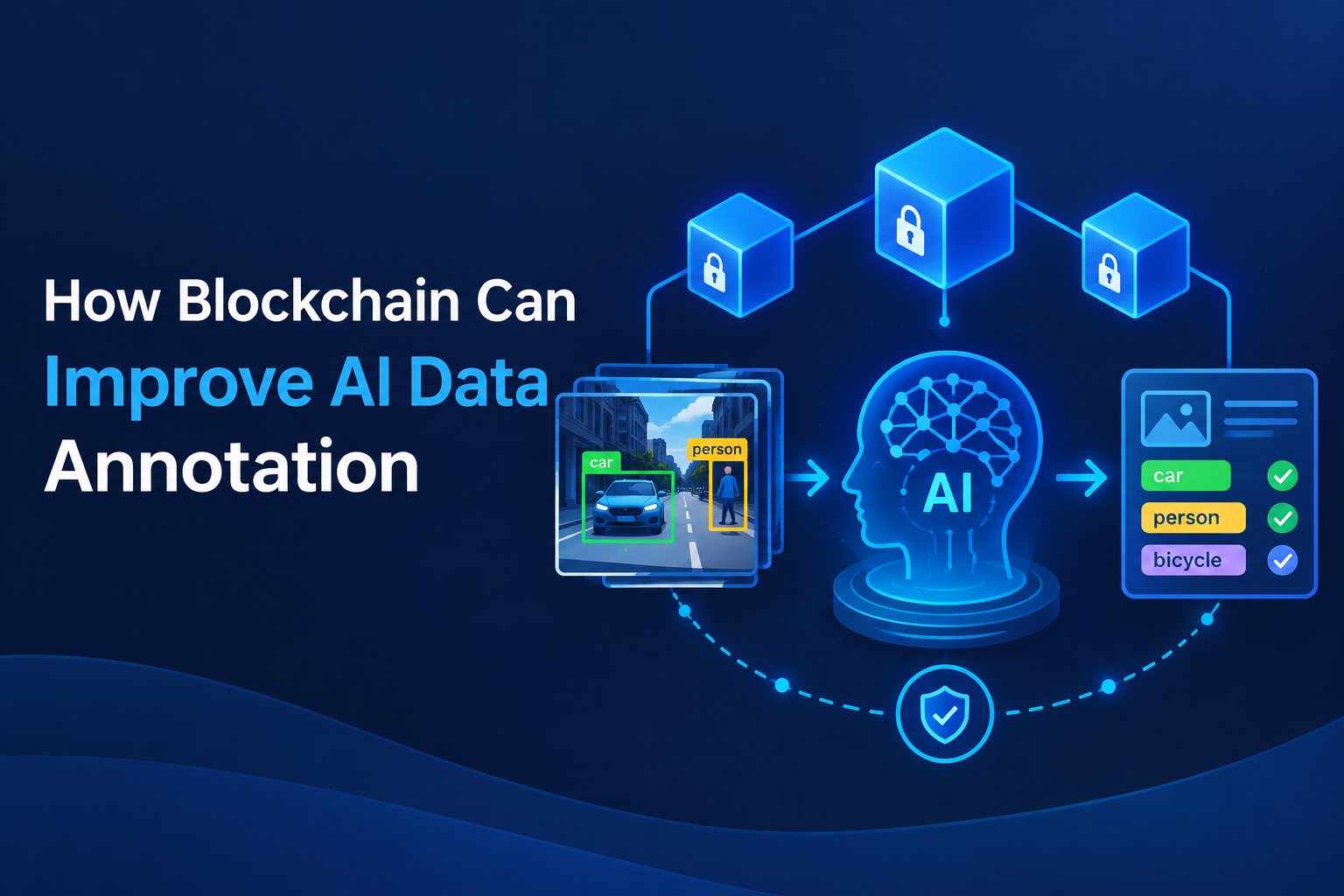
Blockchain does not automatically make data better, but it can introduce infrastructure for transparency and accountability.
One potential benefit is data provenance. Developers can have a clearer record of where information came from and how it was processed. This becomes increasingly important as AI-generated datasets and synthetic data become more common.
Blockchain can also support programmable incentives. Smart contracts can potentially automate payments when contributors complete approved tasks. This can reduce dependence on manual payment processes.
Another advantage is reputation. A decentralized annotation network can maintain contributor histories and quality scores. High-performing contributors may receive greater opportunities, while consistently poor submissions can be restricted.
Staking is another mechanism used by some platforms. Participants may have an economic incentive to submit accurate work because unreliable behavior can affect their rewards or stake.
However, decentralization is not a replacement for good data governance. A blockchain can record inaccurate information just as easily as accurate information. The quality of the underlying annotation process remains critical.
What Makes a Good Decentralized Data Annotation Platform?
Choosing among decentralized data annotation platforms requires more than looking at token incentives or the size of a contributor community.
The first consideration should be dataset quality. A platform should have a clear system for reviewing annotations, resolving disagreements, identifying bad submissions, and measuring accuracy.
The second factor is data specialization. A platform focused on general image annotation may not be the best option for smart-contract datasets. Similarly, a blockchain-focused protocol may not provide the multimodal capabilities required for computer vision.
Scalability is also important. AI models can require millions of data points, so an annotation platform needs a contributor network and workflow capable of handling large projects.
Another important factor is provenance. Developers should understand how data is collected, labeled, reviewed, stored, and delivered. Transparent provenance can become especially important for commercial AI systems.
Privacy should also be considered. Some datasets may contain sensitive or proprietary information. Developers should examine access controls, storage systems, encryption, and permission mechanisms before submitting private data.
Finally, developers should evaluate interoperability. A high-quality dataset is only useful if it can be exported or integrated into the model-development workflow.
Decentralized Data Annotation vs. Traditional Data Labeling
Traditional data labeling typically operates through centralized companies that coordinate workers, projects, quality assurance, and payments.
This model can be highly efficient and remains widely used. Centralized providers may offer mature interfaces, established quality standards, and enterprise support.
Decentralized annotation introduces a different economic structure. Contributors can potentially participate directly in networks, while blockchain systems can record work and automate incentives.
The biggest potential advantage is transparency. Contributors and customers may have greater visibility into how data is created and rewarded.
The main challenge is coordination. A decentralized network needs effective mechanisms for governance, quality control, dispute resolution, and contributor incentives.
Therefore, decentralized systems should not automatically be considered better than centralized platforms. Their value depends on the specific requirements of the AI project.
The Future of Decentralized AI Training Data
The AI industry is increasingly recognizing that high-quality data is a strategic resource. As models become more capable, access to differentiated and specialized datasets could become an important competitive advantage.
This trend may accelerate the development of decentralized AI data marketplaces where contributors can supply information directly to AI builders.
Web3 infrastructure could play a role in this transformation by providing programmable ownership, transparent records, digital incentives, and decentralized coordination.
Another emerging trend is the combination of AI agents and decentralized data networks. Agents may continuously collect, process, evaluate, and learn from information generated across online and blockchain ecosystems.
Human feedback will remain important as well. Even highly automated AI systems often need human evaluation to determine whether outputs are accurate, useful, safe, or contextually appropriate.
The future could therefore involve hybrid systems in which AI performs initial labeling, humans provide specialized judgment, and blockchain infrastructure records contributions and manages incentives.
Challenges Facing Decentralized Data Annotation
Despite its potential, decentralized annotation faces several challenges.
Quality is one of the biggest. Large contributor networks can generate enormous quantities of information, but quantity does not guarantee accuracy.
Another challenge is contributor incentives. If rewards are designed poorly, participants may prioritize speed over accuracy. Effective reputation systems, validation procedures, and incentive structures are therefore essential.
Privacy is also a major consideration. Decentralized networks must balance openness with the need to protect confidential information.
Regulatory uncertainty could also influence the sector. AI companies increasingly need to understand copyright, data licensing, privacy, and consumer-protection requirements. Blockchain records can improve transparency, but they do not automatically resolve legal questions surrounding the underlying data.
Finally, interoperability remains important. For decentralized data annotation to become mainstream, datasets need to work smoothly with existing AI development tools, machine-learning frameworks, storage systems, and model-training pipelines.
Conclusion
The emergence of decentralized data annotation platforms reflects a broader shift in how the AI industry thinks about data. Instead of treating training data as a resource controlled exclusively by centralized organizations, decentralized systems attempt to create open networks where contributors, validators, developers, and data owners can participate in a shared ecosystem.
PublicAI stands out for its broad multimodal data infrastructure and distributed validation model. Sahara AI focuses on decentralized AI services and data contribution, while Pundi AI explores tokenized data and decentralized AI economics. LabelData emphasizes on-chain labeling, quality systems, and data assets, while ChainLabel takes a more specialized approach to Web3-focused datasets.
