

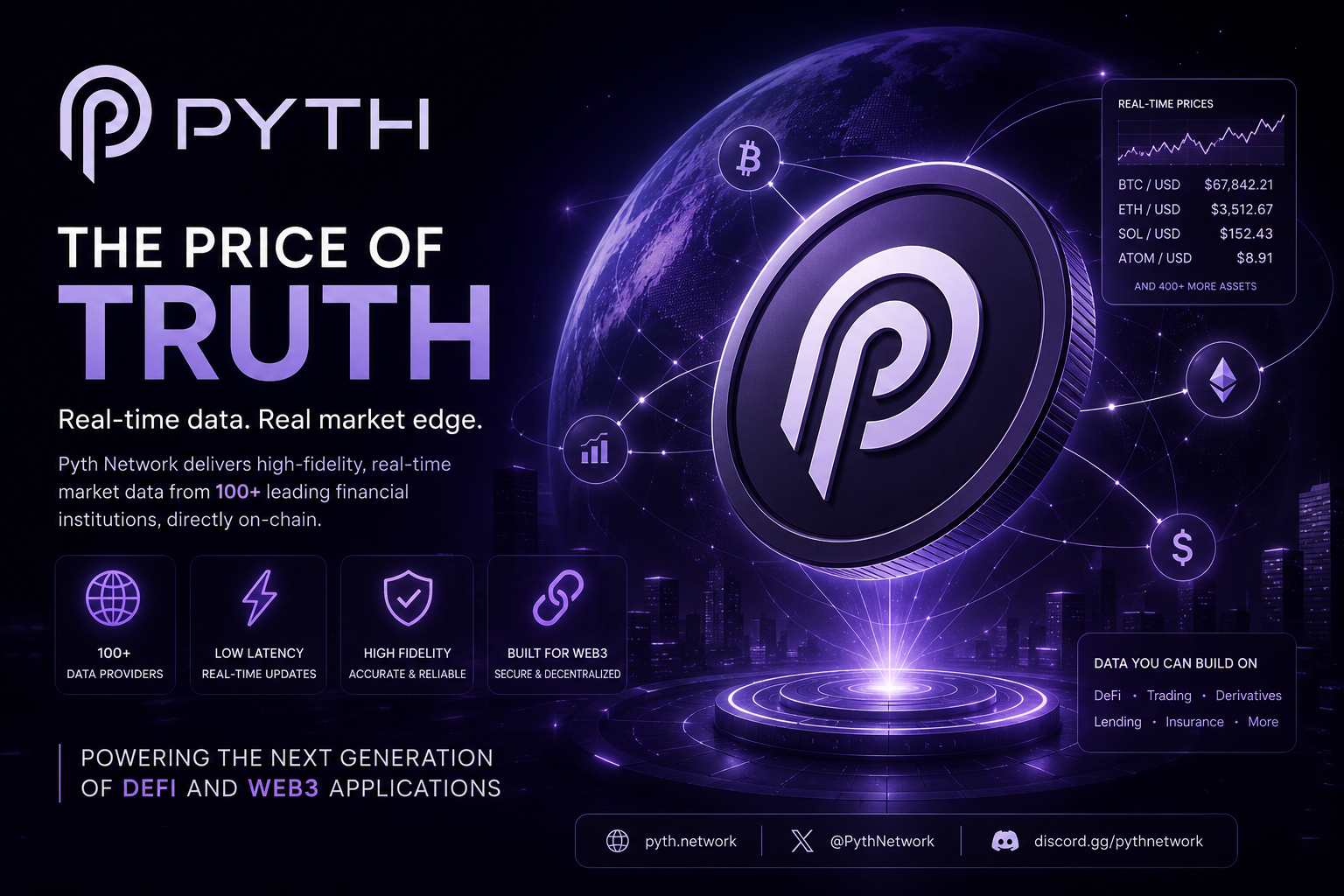

As decentralized finance (DeFi) continues to evolve, reliable and accurate market data has become one of the most important components of blockchain infrastructure. Smart contracts cannot access real-world information on their own, creating the need for oracle networks that deliver external data to blockchains. Pyth Network (PYTH) has emerged as one of the leading oracle solutions by providing real-time financial data directly from first-party sources such as exchanges, market makers, and trading firms.
Unlike traditional oracle systems that often rely on third-party data aggregators, Pyth Network collects market information directly from institutions and delivers it to decentralized applications (dApps) across multiple blockchain ecosystems. This innovative approach has made Pyth a critical infrastructure layer for modern DeFi applications, including decentralized exchanges, lending protocols, derivatives platforms, and asset management tools.
What Is Pyth Network?
Pyth Network is a decentralized oracle network designed to provide high-quality, real-time financial market data to blockchain applications. The project aims to solve the “oracle problem” by securely connecting off-chain market data with on-chain smart contracts.
The network aggregates pricing information from over 120 institutional data providers, including major exchanges, trading firms, and market makers. These providers contribute data directly to the network, ensuring greater accuracy and transparency compared to traditional oracle models.
Pyth supports a wide range of asset classes, including:
- Cryptocurrencies
- Equities
- Commodities
- Foreign Exchange (Forex)
- Futures
- Indexes
This broad coverage enables developers to build sophisticated financial applications using reliable market data.
How Pyth Network Works
Pyth Network follows a unique architecture that differs from many traditional oracle solutions.
Data Collection
Institutional publishers submit price information directly to the Pyth oracle network. These contributors include exchanges, liquidity providers, trading firms, and financial institutions. Multiple publishers provide data for each asset to improve reliability and reduce manipulation risks.
Data Aggregation
The Pyth Oracle Program collects pricing information from authorized publishers and combines it into a single aggregate price feed. The system also calculates confidence intervals, giving developers additional information about data reliability and market uncertainty.
Cross-Chain Distribution
After aggregation, Pyth distributes price feeds across more than 100 blockchain networks. This cross-chain compatibility allows developers on various ecosystems to access the same trusted data source.
The Pull Oracle Model
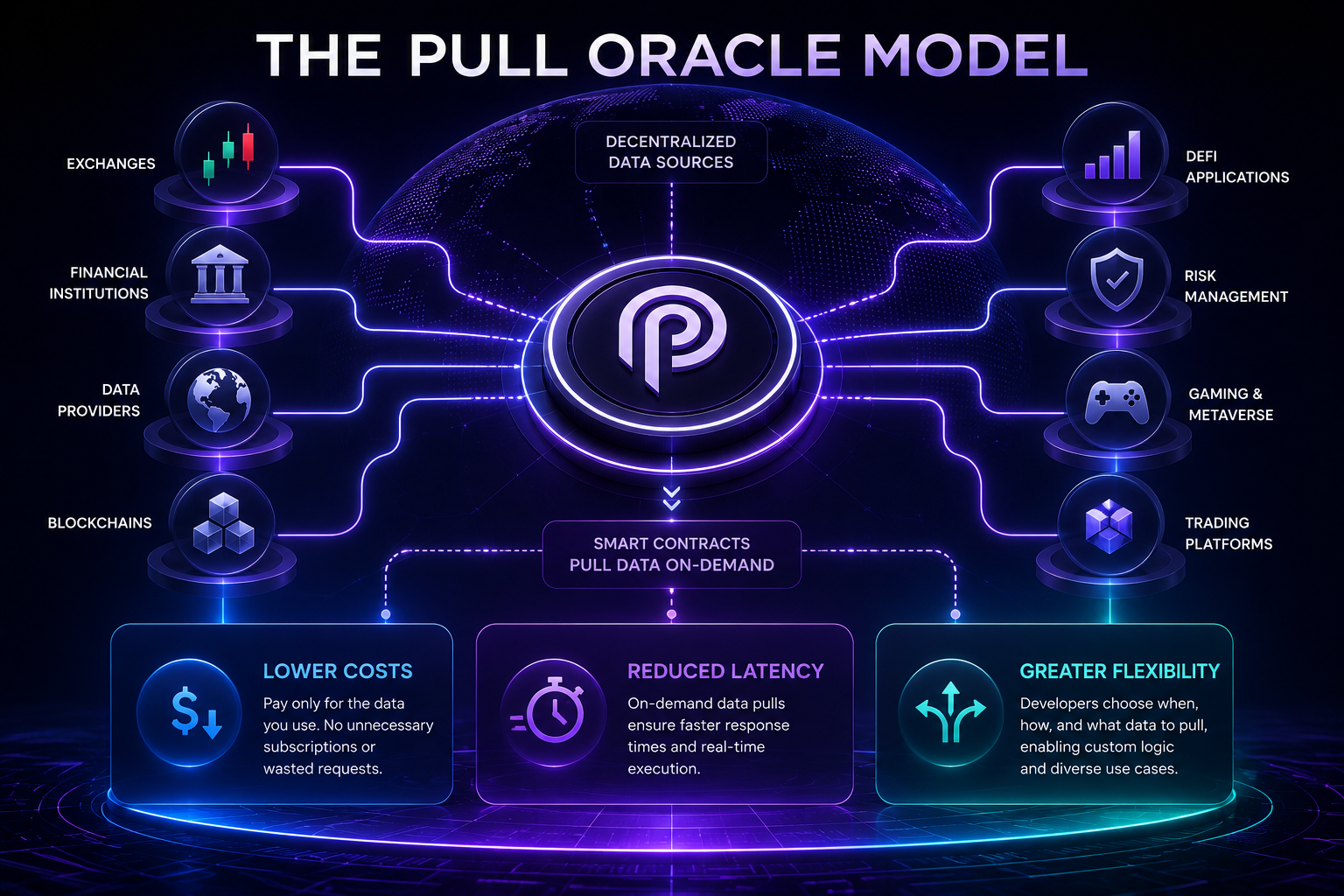
One of Pyth Network’s most innovative features is its pull oracle architecture.
Traditional oracle systems use a “push” model, where oracle operators continuously update prices on-chain regardless of demand. This can create unnecessary costs and inefficiencies.
Pyth instead uses a “pull” model. In this system, applications request the latest market data only when needed. Users or protocols can fetch the most recent price updates and submit them on-chain before executing transactions. This design offers several advantages:
Lower Costs
Price updates occur only when required, reducing unnecessary blockchain transaction fees.
Reduced Latency
Applications can access the latest market data directly from Pyth’s low-latency network, improving execution speed.
Greater Flexibility
Different protocols can choose their own update frequency based on specific needs and risk profiles.
Key Features of Pyth Network
First-Party Market Data
One of Pyth’s strongest advantages is its direct relationship with financial institutions. Instead of relying on third-party aggregators, Pyth sources data directly from the original publishers. This improves data quality and accuracy.
Real-Time Price Feeds
Pyth Core offers rapid updates, with data refreshing approximately every 400 milliseconds. This speed is particularly valuable for high-frequency trading applications and derivatives platforms.
Confidence Intervals
Each price feed includes confidence intervals that help developers assess the certainty of pricing information during volatile market conditions.
Multi-Chain Support
Pyth price feeds are available across more than 100 blockchain ecosystems, making it one of the most widely accessible oracle networks in the industry.
PYTH Token Utility
The PYTH token serves as the native utility and governance token of the Pyth ecosystem.
Governance
Token holders can participate in governance decisions that influence the future development of the network. This decentralized governance structure helps ensure community involvement.
Staking
PYTH tokens can be staked through Oracle Integrity Staking mechanisms. Staking helps align incentives among publishers, validators, and token holders while supporting data quality and network security.
Ecosystem Participation
The token also plays a role in network operations, ecosystem incentives, and future protocol developments. As Pyth adoption increases, the token may benefit from broader ecosystem participation and utility expansion.
Pyth Network Use Cases
Decentralized Exchanges (DEXs)
DEXs require accurate price feeds to facilitate trading and determine fair market values. Pyth provides reliable pricing information for numerous trading pairs.
Lending and Borrowing Protocols
DeFi lending platforms use oracle data to determine collateral values and trigger liquidations when necessary.
Derivatives Trading
Perpetual futures, options, and synthetic assets depend heavily on real-time price information. Pyth’s low-latency feeds make it well-suited for these applications.
Asset Management Platforms
Portfolio management tools and investment protocols use Pyth data to calculate net asset values and portfolio performance.
Recent Developments
Pyth Network continues expanding beyond traditional price feeds.
Recent initiatives include:
- Pyth Pro for institutional-grade market data services.
- Pyth Indices, offering 24/7 index products for modern financial markets.
- Pyth Data Marketplace, enabling institutions to distribute proprietary datasets across blockchain ecosystems.
The ecosystem has also introduced mechanisms designed to connect network revenue with token value through initiatives such as the PYTH Reserve. According to community announcements, this program uses a portion of protocol revenue to acquire PYTH tokens from the market.
Advantages of Pyth Network
Pyth offers several competitive advantages:
- Direct institutional data sourcing
- High-frequency price updates
- Confidence interval reporting
- Scalable pull-oracle architecture
- Extensive cross-chain compatibility
- Growing ecosystem adoption
These strengths position Pyth as one of the most innovative oracle solutions available today.
Challenges and Risks
Despite its strengths, Pyth faces several challenges:
Competition
The oracle sector is highly competitive, with multiple established providers serving the blockchain industry.
Market Volatility
Like most crypto projects, PYTH token performance is influenced by broader cryptocurrency market conditions.
Regulatory Uncertainty
As blockchain technology continues to evolve, changing regulations could affect the adoption and operation of decentralized financial infrastructure.
Conclusion
Pyth Network has established itself as a major player in the blockchain oracle industry by delivering high-quality financial data directly from institutional sources. Its innovative pull-oracle model, extensive cross-chain support, and focus on first-party data distinguish it from many traditional oracle providers.
As decentralized finance expands and more applications require accurate real-time market information, Pyth’s infrastructure is positioned to play an increasingly important role in connecting global financial markets with blockchain technology. Whether powering decentralized exchanges, lending platforms, or advanced trading systems, Pyth Network is helping build the next generation of financial infrastructure.
