


The internet has changed dramatically since its beginning. In its early years, websites mainly provided information that people could read. Later, social media platforms, online marketplaces, and interactive applications transformed the internet into a place where users could communicate, create content, shop, and build digital communities. Today, another major development is attracting attention: Web3.
But what is Web3, and why are technology companies, developers, investors, and internet users discussing it? Web3 refers to a developing version of the internet built around decentralization, blockchain technology, digital ownership, and user-controlled applications. Its central idea is to give people greater control over their digital identities, information, and assets rather than depending entirely on large technology companies.
Traditional internet services usually operate through centralized platforms. These platforms manage user accounts, store information, and control access to their services. Web3 introduces a different approach by using blockchain networks and other decentralized technologies to distribute certain responsibilities across a network of participants.
The concept is closely connected with cryptocurrency, smart contracts, decentralized finance (DeFi), non-fungible tokens (NFTs), and decentralized applications (dApps). These technologies make it possible to create digital services that can operate without relying on a single company to manage every transaction or interaction.
However, Web3 is still developing. It offers opportunities for innovation but also faces challenges involving security, usability, regulation, scalability, and adoption. Understanding its basic principles can help explain why many people consider it an important direction for the future of the internet.
What Is Web3?
Web3 is a vision of an internet where users can interact with digital services through decentralized networks and maintain greater control over their digital assets and identities. Instead of depending completely on centralized companies, Web3 applications can use blockchain technology to record transactions and coordinate activities across distributed computer networks.
The term Web3 is commonly associated with Ethereum co-founder Gavin Wood, who helped popularize the concept in 2014. The broader vision is to create an internet that is more open, transparent, and less dependent on centralized intermediaries.
In the traditional internet, users generally access services through accounts controlled by individual companies. For example, a social media platform manages its database, determines its policies, and controls how users interact with its service. In a Web3 environment, some applications use decentralized protocols that allow users to connect through digital wallets and interact with blockchain-based systems.
This does not mean every Web3 service is completely decentralized. Some applications still depend on centralized companies, servers, or infrastructure. The level of decentralization varies depending on how a project is designed and operated.
The main goal of Web3 is to make digital participation more open while allowing users to have a stronger relationship with their online identities, information, and assets.
The Evolution of the Internet
To understand Web3 properly, it helps to examine how the internet has developed. The terms Web1, Web2, and Web3 describe different stages of the internet’s evolution. They are useful ways to understand changing technologies, although the boundaries between these stages are not always exact.
Web1: The Read-Only Internet
Web1 describes the early internet, which became publicly accessible during the 1990s. Most websites were relatively simple and focused on displaying information. Visitors could read articles, explore basic pages, and access online resources, but they had limited opportunities to interact with website owners or other users.
Websites were often static, meaning their content did not change frequently. Businesses and organizations published information, while visitors mainly consumed it.
This period is commonly described as the read-only web because users primarily received information rather than actively creating and sharing content.
Web2: The Interactive Internet
Web2 introduced a more interactive internet. Social media networks, video-sharing websites, online shopping platforms, and cloud-based applications allowed users to create content and communicate with others.
Platforms such as social networks and online marketplaces became important parts of everyday life. Users could publish videos, upload photographs, write reviews, sell products, and participate in online communities.
However, much of Web2 is controlled by centralized companies. These businesses manage user accounts, collect information, operate servers, and establish platform policies. Although users create significant amounts of content, the platforms generally control the infrastructure through which that content is shared.
This model is often called the read-write web because users can both consume and produce digital information.
Web3: The Read-Write-Own Internet
Web3 introduces the idea of a read-write-own internet. Its purpose is to give users more control over digital assets and participation through decentralized technologies.
For example, a Web3 application may allow someone to connect a cryptocurrency wallet instead of creating a traditional username and password account. The user can then interact with blockchain-based services and manage supported digital assets through that wallet.
Blockchain records can provide transparency, while smart contracts can automatically execute predefined instructions. These features make it possible to build applications that do not require a traditional central authority for every operation.
Web3 is not a complete replacement for Web2. Both models currently operate alongside one another, and many modern services combine centralized infrastructure with decentralized technologies.
How Does Web3 Work?
Web3 works through several connected technologies that support decentralized communication, digital transactions, and application development. Blockchain networks provide shared records, cryptocurrency can support transactions, and smart contracts allow developers to create automated services.
Understanding these components makes it easier to see how Web3 applications function.
Blockchain Technology
Blockchain technology is one of the foundations of Web3. A blockchain is a distributed digital ledger that records information in groups of data called blocks. These blocks are connected in chronological order, forming a chain.
Instead of keeping the transaction record in one central database, a blockchain network distributes copies of its ledger among participating computers, often called nodes.
Depending on the network’s design, participants use a consensus mechanism to agree on valid transactions and updates. Once information is confirmed and recorded, changing it can be difficult, particularly on networks with strong security and decentralization.
Blockchain technology supports transparency because participants can independently verify information recorded on a public network. However, public visibility does not mean every blockchain transaction reveals a person’s real-world identity. Wallet addresses are generally pseudonymous, although transaction patterns and other information may sometimes connect them to individuals.
Cryptocurrencies and Digital Assets
Cryptocurrencies are digital assets that can be transferred and recorded using blockchain networks. They play an important role in many Web3 ecosystems.
For example, Ether (ETH) is the native cryptocurrency of Ethereum. It is used to pay transaction fees and support activities on the network. Other blockchain networks have their own native assets with different functions.
Cryptocurrencies can also be used within decentralized applications, including financial services, blockchain games, and digital marketplaces.
However, not every digital asset has the same purpose. Some cryptocurrencies are designed to support network operations, while others represent governance rights, access to services, or other forms of digital utility.
Cryptocurrency prices can change significantly, and owning a digital token does not automatically provide ownership of a company, guaranteed income, or legal rights. Users should understand the purpose and risks of an asset before interacting with it.
Smart Contracts
Smart contracts are programs stored and executed on blockchain networks. They automatically perform specific actions when predefined conditions are satisfied.
For example, a smart contract could manage a digital marketplace transaction. When the required conditions are met, the contract can transfer a digital asset and release payment according to its programmed rules.
Smart contracts reduce the need for certain intermediaries because the application follows rules encoded in software. However, they are not necessarily traditional legal contracts, and their behavior depends on the quality of their code and the network supporting them.
Programming errors can create security vulnerabilities. For this reason, auditing and testing smart contracts are important parts of responsible Web3 development.
Digital Wallets
A Web3 wallet allows users to manage blockchain accounts and interact with decentralized applications. It typically stores or manages the cryptographic keys needed to authorize transactions.
A wallet can be used to send and receive cryptocurrency, connect to decentralized applications, and manage supported digital assets.
Unlike many traditional online accounts, blockchain wallets often rely on private keys or recovery phrases rather than a username and password controlled by a service provider.
This creates greater personal responsibility. Losing access to a private key or recovery phrase can result in permanent loss of access to the associated assets. Users should never share recovery phrases or enter them into suspicious websites.
Key Features of Web3
Web3 is built around several principles that distinguish it from conventional internet services. Not every project includes all these features, but they represent the broader direction of the Web3 ecosystem.
Decentralization
Decentralization means distributing control and operations across multiple participants instead of placing all authority in one organization.
In a decentralized blockchain network, multiple computers help maintain the system and verify transactions. This structure can reduce dependence on a single operator.
However, decentralization exists on a spectrum. A project may use a public blockchain while still depending on centralized websites, development teams, hosting providers, or decision-making groups.
User Ownership and Control
One of the most discussed ideas behind Web3 is digital ownership. Users can hold certain blockchain-based assets directly in wallets rather than relying entirely on a platform to maintain their balances.
For example, someone may own a supported digital collectible represented by an NFT. The asset can be transferred between compatible wallets or applications, depending on its design.
Nevertheless, blockchain ownership does not automatically mean ownership of copyright, commercial rights, or the underlying artwork. Those rights depend on the relevant license and legal agreements.
Transparency
Many public blockchain networks allow anyone to examine transaction records and verify activity.
This transparency can help users understand how funds move through a system and whether certain transactions have occurred. Developers and researchers can also examine public blockchain data to study network activity.
However, transparency does not guarantee that a project is trustworthy. Users still need to evaluate its developers, code, governance, and financial structure.
Permissionless Access
Some Web3 applications are designed to be permissionless, meaning people can interact with them without requesting approval from a central company.
A user with a compatible wallet and the required network access may be able to use a decentralized application directly.
This can create opportunities for people who face barriers when accessing traditional financial or digital services. However, access may still be limited by internet availability, local laws, technical requirements, and application restrictions.
Interoperability
Interoperability refers to the ability of different applications and networks to communicate or work together.
Web3 developers are exploring ways to make digital assets and services more useful across multiple platforms. For example, certain blockchain assets may be supported by several compatible applications.
However, interoperability is not automatic. Different networks use different technical standards, and transferring assets between them can involve additional risks.
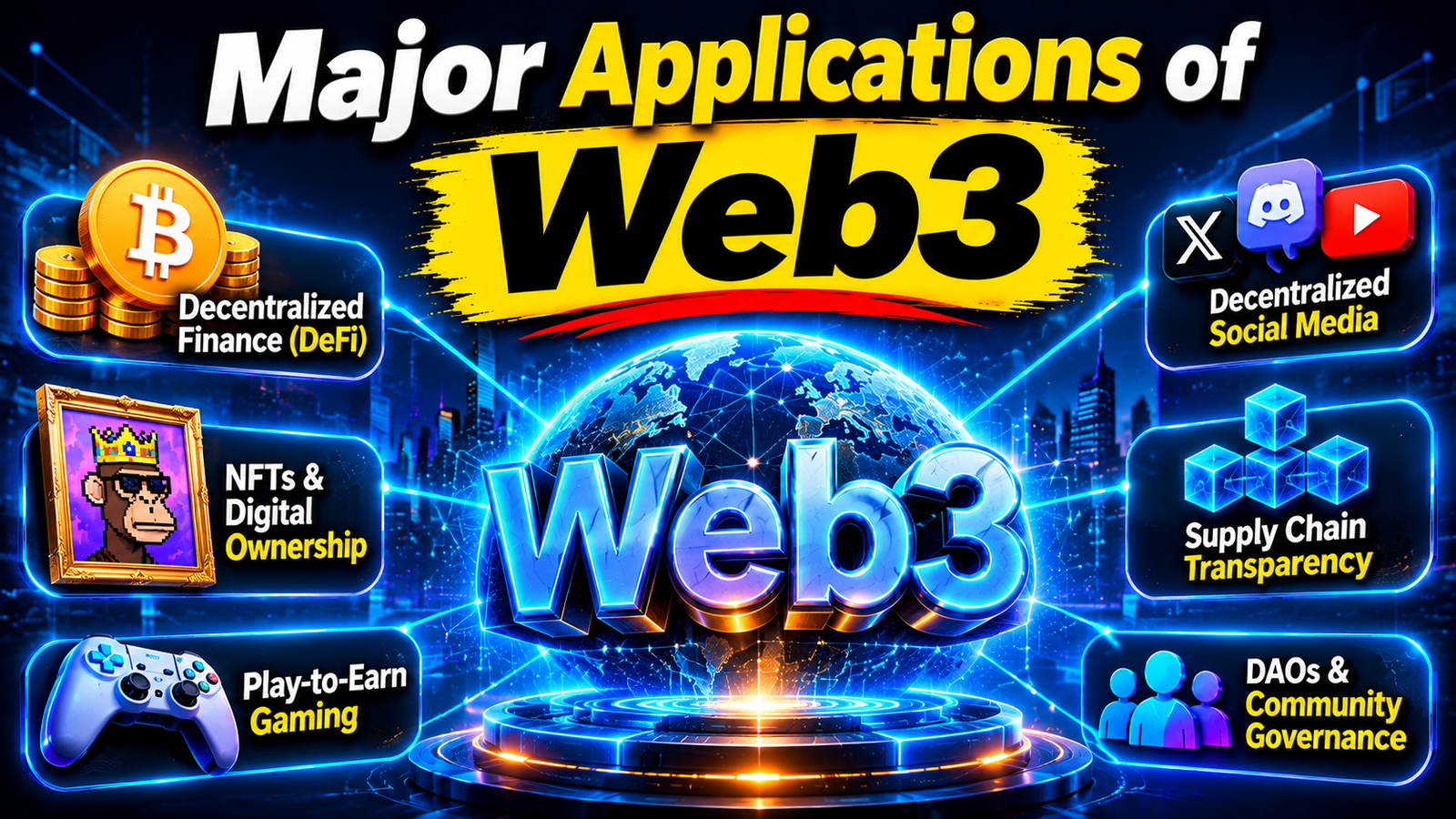
Web3 is not limited to cryptocurrency trading. Its technologies are being explored across financial services, digital entertainment, online communities, identity systems, and other areas.
Decentralized Finance (DeFi)
Decentralized finance, commonly known as DeFi, refers to financial applications built using blockchain technology and smart contracts.
DeFi services can support activities such as exchanging digital assets, providing liquidity, and borrowing or lending through automated protocols.
Traditional financial institutions generally manage transactions through centralized systems. DeFi applications attempt to provide some financial services through publicly accessible blockchain-based software.
However, DeFi carries significant risks, including smart contract vulnerabilities, unstable token prices, liquidity problems, and scams. Access to a protocol does not guarantee that users will receive a particular return or be able to withdraw assets whenever they want.
Non-Fungible Tokens (NFTs)
Non-fungible tokens, or NFTs, are blockchain-based tokens that represent distinct digital or physical assets.
Unlike interchangeable cryptocurrencies, NFTs have individual identifiers and can represent unique items. Examples include digital artwork, collectibles, game-related assets, and certain forms of membership or event access.
NFTs can help establish a verifiable record associated with a particular token. However, purchasing an NFT does not necessarily transfer copyright or exclusive rights to the content it represents.
Their usefulness depends on the project’s design, supporting applications, and the rights granted to the owner.
Decentralized Applications (dApps)
Decentralized applications, commonly called dApps, use blockchain networks and smart contracts to provide digital services.
Examples include decentralized exchanges, blockchain-based games, digital marketplaces, and community platforms.
Unlike conventional applications that rely entirely on company-managed databases, dApps can use blockchain records to manage certain functions. Some still depend on centralized websites or other services for parts of their operation.
Web3 Gaming
Web3 gaming explores the use of blockchain-based assets in video games. Players may be able to own supported digital items, trade certain collectibles, or use compatible assets across different applications.
Traditional games generally keep their in-game items within the developer’s system. Blockchain-based games attempt to provide players with more direct control over selected assets.
However, the presence of NFTs or cryptocurrencies does not automatically make a game enjoyable or financially valuable. Game quality, fair design, security, and long-term support remain important.
Decentralized Identity
Web3 also explores decentralized identity systems, which aim to give people more control over how their digital credentials are managed and shared.
Instead of depending entirely on one service provider, users may be able to hold verifiable credentials and present selected information when needed.
This approach could support digital verification while reducing unnecessary sharing of personal information. Nevertheless, privacy depends on the specific identity system, its technical design, and how organizations use the information.
Web3 vs. Web2: What Is the Difference?
Web2 and Web3 represent different approaches to building and managing online services.
Web2 generally relies on centralized platforms. Companies operate servers, maintain databases, manage user accounts, and control many aspects of their applications. This model has helped create convenient services used by billions of people.
Web3 introduces decentralized networks and user-controlled digital assets. Instead of relying exclusively on a company’s internal database, certain Web3 applications use blockchain records and smart contracts to manage transactions.
The ownership model is another important difference. In Web2, users generally access content and services through accounts managed by platforms. In Web3, users may hold blockchain assets directly through wallets and interact with multiple compatible applications.
There are also differences in responsibility. Web2 companies usually manage account recovery and customer support. In many Web3 systems, users must protect their own private keys and recovery phrases.
Neither model is perfect. Web2 often provides better convenience and customer support, while Web3 offers different possibilities for transparency and user control. Many future applications may combine elements of both approaches.
Benefits of Web3
Web3 offers several potential advantages that explain its growing interest among developers and technology businesses.
One important benefit is greater control over supported digital assets. Users can hold certain tokens directly in their wallets and transfer them without relying on a single platform’s internal account system.
Another potential advantage is transparency. Public blockchain records allow users to examine transactions and verify certain activities independently. This can make some digital systems easier to audit.
Web3 may also improve access to digital services. Permissionless applications can allow people to interact with certain financial and digital tools without going through traditional intermediaries. This possibility is particularly relevant in areas where access to conventional services is limited.
In addition, smart contracts can automate processes that would otherwise require manual coordination. Automated execution may reduce delays and simplify certain transactions.
Finally, Web3 encourages experimentation with new business models. Developers can create decentralized marketplaces, digital communities, token-based memberships, and applications that combine multiple blockchain technologies.
These advantages are potential benefits rather than guarantees. Their actual value depends on the quality, security, and usefulness of each project.
Challenges and Risks of Web3
Despite its potential, Web3 faces several challenges that must be addressed before decentralized applications can become suitable for a wider audience.
Security Vulnerabilities
Blockchain networks may have strong security designs, but applications built on them can still contain weaknesses. Poorly written smart contracts, compromised private keys, phishing websites, and malicious applications can put users’ assets at risk.
Security audits, careful development, and responsible wallet practices are essential. Users should also be cautious of projects promising guaranteed profits or asking for sensitive wallet information.
Scalability and Network Fees
Some blockchain networks experience congestion when transaction demand increases. This can lead to slower processing and higher transaction fees.
Developers are working on solutions such as improved network designs and layer-2 technologies. These systems aim to increase transaction capacity and reduce costs while maintaining connections to underlying blockchain networks.
However, scalability solutions can introduce additional technical complexity and security considerations.
Complex User Experience
Web3 applications can be difficult for beginners. Users may need to understand wallets, private keys, network selection, transaction fees, and smart contract permissions.
A mistaken transaction may be difficult or impossible to reverse. This makes clear interfaces, educational resources, and better account recovery options important for wider adoption.
Regulatory Uncertainty
Governments around the world are developing approaches to cryptocurrency, blockchain applications, digital assets, and decentralized financial services.
Rules differ between countries and may change over time. Projects and users need to consider applicable laws, consumer protection requirements, taxation, and financial regulations.
Environmental Considerations
The environmental impact of Web3 depends partly on the blockchain network’s consensus mechanism.
Some proof-of-work networks require substantial computing power. Many proof-of-stake networks use a different process that generally requires significantly less energy for transaction validation.
It is therefore inaccurate to treat every blockchain network as having the same environmental impact.
Is Web3 the Future of the Internet?
Web3 could become an important part of the internet’s future, but its long-term success is not guaranteed.
Its development depends on whether decentralized technologies can provide practical benefits that ordinary users genuinely need. Better security, simpler applications, affordable transactions, and reliable infrastructure will all influence adoption.
Businesses may use blockchain technology for specific purposes, such as tracking digital records, managing tokenized assets, or automating transactions. Developers may continue building decentralized applications that combine blockchain networks with conventional software.
At the same time, centralized platforms are unlikely to disappear simply because Web3 exists. Many users value convenience, customer support, familiar interfaces, and reliable services.
The future internet may therefore combine Web2 and Web3 technologies rather than choosing one model exclusively. The most successful applications will likely be those that solve real problems instead of using blockchain technology simply because it is popular.
How Can Beginners Get Started With Web3?
Learning about Web3 does not require advanced programming knowledge. Beginners can start by understanding blockchain fundamentals, digital wallets, cryptocurrencies, and smart contracts.
Exploring educational resources from established blockchain projects can help explain how decentralized networks operate. Reading documentation and learning the difference between legitimate applications and suspicious websites are also useful starting points.
A basic understanding of wallet security is especially important. Private keys and recovery phrases should remain confidential, and users should never share them with people claiming to offer technical support.
It is also useful to understand the risks before interacting with decentralized applications. Blockchain transactions may be irreversible, and digital assets can lose value. Learning about the technology should come before making financial decisions.
For developers, learning programming languages and tools used in blockchain development can provide a foundation for building decentralized applications. For general users, understanding how Web3 works is enough to evaluate its benefits and limitations more confidently.
Conclusion
Web3 represents an evolving vision of the internet built around decentralization, blockchain technology, digital ownership, and user-controlled applications. It aims to give people greater control over selected digital assets and create online services that do not depend entirely on centralized platforms.
However, Web3 still faces important challenges, including security risks, complicated user experiences, scalability limitations, regulatory uncertainty, and environmental concerns. Its success will depend on whether developers can solve these problems and create services that are genuinely useful.
