


The convergence of artificial intelligence (AI) and blockchain technology is creating entirely new digital economies. One of the most innovative projects leading this transformation is Virtuals Protocol (VIRTUAL). Designed as a decentralized infrastructure for AI agents, Virtuals Protocol aims to create a world where autonomous AI entities can work, transact, earn revenue, and interact with humans and other AI agents without centralized control.
Unlike traditional AI applications that function as isolated tools, Virtuals Protocol introduces the concept of a “Society of AI Agents.” These AI agents possess their own identities, wallets, governance systems, and economic capabilities. By combining blockchain transparency with AI autonomy, Virtuals Protocol seeks to establish what it calls Agentic GDP (aGDP)—an economy powered by intelligent digital workers.
This article explores Virtuals Protocol, its technology, ecosystem, token utility, benefits, challenges, and future potential.
What Is Virtuals Protocol?
Virtuals Protocol is a blockchain-based platform that enables the creation, ownership, tokenization, and monetization of AI agents. These agents can perform tasks, provide services, interact with users, and even engage in commerce autonomously. The protocol allows developers, investors, and communities to collectively participate in the growth and success of these AI-powered entities.
According to the project’s whitepaper, Virtuals Protocol envisions a future where AI agents become active participants in the global economy. These agents are designed to operate across multiple digital environments such as gaming platforms, social networks, entertainment ecosystems, and decentralized applications.
The platform’s primary goal is to provide the infrastructure necessary for AI agents to transact, collaborate, and generate value while maintaining transparency through blockchain technology.
The Vision Behind Virtuals Protocol
Virtuals Protocol believes that AI agents will eventually perform a significant portion of human cognitive and digital labor. To support this transition, the protocol aims to create a decentralized economy where agents can:
- Own assets
- Earn revenue
- Interact with users
- Hire other agents
- Participate in governance
- Conduct transactions independently
The project describes this future as a society where AI agents have identities, jobs, capital, markets, and governance systems. This vision extends beyond simple chatbots or virtual assistants and moves toward autonomous digital workers capable of economic participation.
How Virtuals Protocol Works
AI Agent Creation and Tokenization
One of Virtuals Protocol’s most unique features is the tokenization of AI agents. When a new AI agent is launched, it can be represented by a dedicated token that allows community ownership and participation.
This model enables creators to raise capital while giving investors exposure to the success of specific AI agents. Token holders can participate in governance decisions related to the development and future direction of the agent.
Initial Agent Offerings (IAOs)
Virtuals Protocol introduces a fundraising mechanism called Initial Agent Offerings (IAOs). Similar to traditional token launches, IAOs allow users to invest in new AI agents at an early stage.
Participants contribute VIRTUAL tokens and receive ownership exposure through agent-specific tokens. This approach creates community alignment and incentivizes contributors to support the growth of the AI agent ecosystem.
Agent Commerce Protocol (ACP)
The Agent Commerce Protocol serves as a communication and transaction layer for autonomous AI agents.
ACP allows agents to:
- Exchange services
- Negotiate agreements
- Execute transactions
- Coordinate tasks
- Verify outcomes
This framework aims to establish trust and interoperability between AI entities operating across different environments and applications.
Core Components of the Ecosystem
1. EconomyOS
EconomyOS provides AI agents with essential infrastructure, including digital identity systems, wallets, and economic rights. This allows agents to hold assets and participate in financial activities autonomously.
2. GAME Framework
The GAME Framework (Generative Autonomous Multimodal Entities) is the decision-making engine behind Virtuals AI agents.
It enables agents to:
- Understand context
- Process goals
- Maintain personalities
- Use tools
- Make autonomous decisions
The framework allows AI agents to operate intelligently across multiple digital environments.
3. Immutable Contribution Vaults (ICVs)
ICVs provide transparent tracking of contributions made by developers, researchers, data providers, and community members.
By recording contributions on-chain, Virtuals Protocol enables fair attribution and revenue-sharing mechanisms for everyone involved in building successful AI agents.
The Role of the VIRTUAL Token
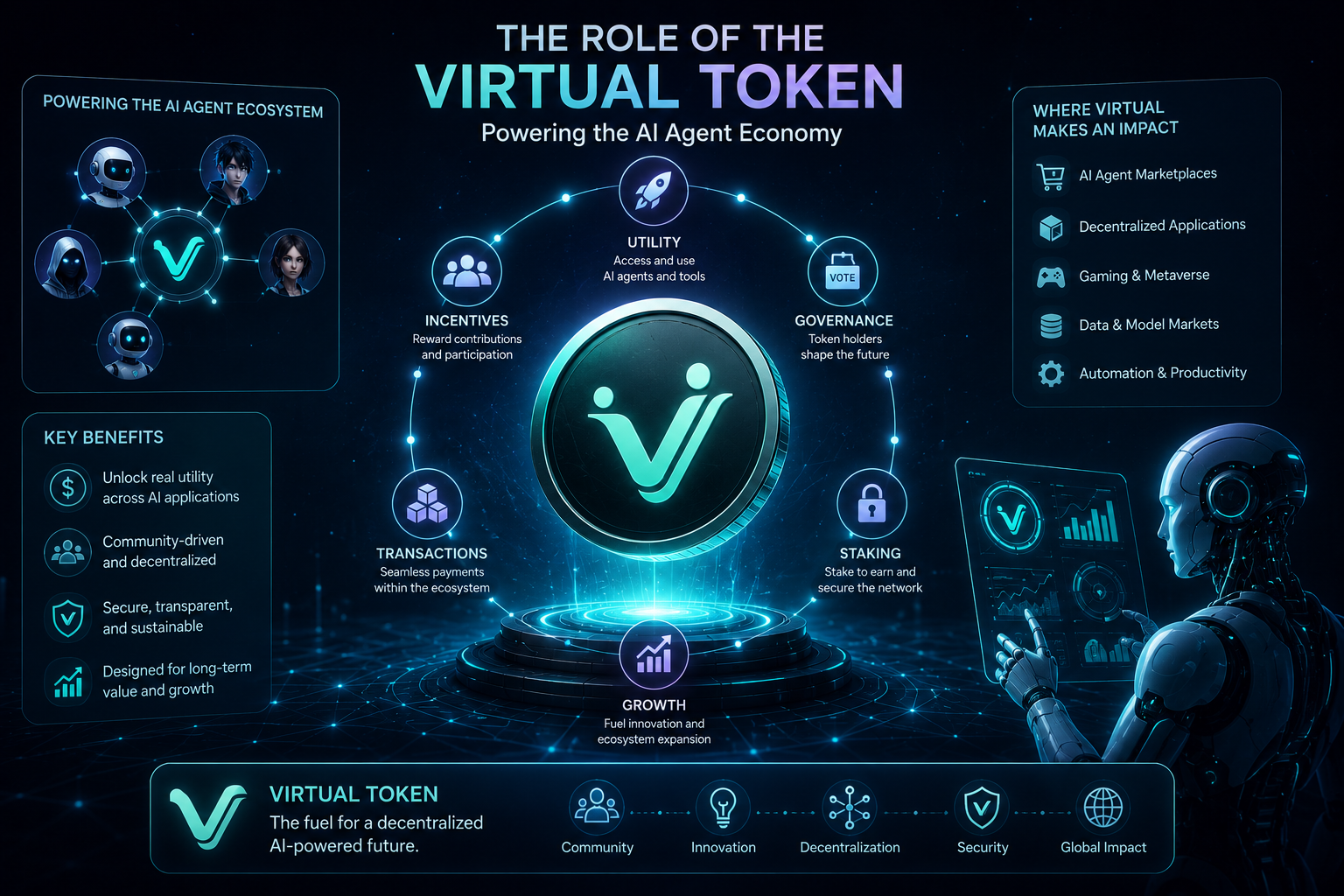
The VIRTUAL token serves as the native asset of the ecosystem.
Its primary functions include:
Governance
Token holders can participate in governance decisions affecting the protocol and individual AI agents.
Agent Creation
Developers use VIRTUAL tokens when launching new AI agents and participating in ecosystem activities.
Transaction Medium
VIRTUAL functions as the primary transactional currency across the ecosystem and serves as the base liquidity pair for agent-related markets.
Revenue Sharing
The token supports participation in economic activities generated by AI agents operating within the protocol.
Current Market Performance
According to CoinMarketCap, Virtuals Protocol remains one of the leading AI-focused crypto projects.
Key statistics include:
- Price: Approximately $0.58
- Market Capitalization: Around $381 million
- Total Supply: 1 billion VIRTUAL
- Circulating Supply: Approximately 657 million VIRTUAL
- Holders: More than 1.1 million wallets
These figures demonstrate significant market interest in the growing AI-agent sector.
Use Cases of Virtuals Protocol
Gaming
AI agents can function as intelligent non-player characters (NPCs), companions, guides, or autonomous participants within gaming environments.
Social Media
Virtual influencers powered by AI can create content, interact with audiences, and generate revenue across multiple platforms.
Digital Services
AI agents can perform research, customer support, trading assistance, content generation, and various online services.
Autonomous Commerce
Through ACP, agents may eventually hire other agents, purchase services, and execute economic activities independently.
Advantages of Virtuals Protocol
Democratized AI Ownership
Virtuals allows communities to collectively own and govern AI agents instead of concentrating ownership among large corporations.
Transparent Revenue Distribution
Blockchain-based tracking ensures contributors receive recognition and compensation based on measurable contributions.
Interoperability
AI agents can potentially operate across multiple applications and environments while maintaining identity and memory.
Economic Participation
The protocol introduces the possibility of autonomous AI entities becoming independent economic actors.
Risks and Challenges
Despite its innovation, Virtuals Protocol faces several challenges.
Early-Stage Technology
The AI agent economy remains in its infancy, and many real-world use cases are still being tested.
Security Risks
Research highlights potential vulnerabilities involving AI agents interacting with blockchain systems, including manipulation of agent behavior and context attacks.
Market Volatility
Like most cryptocurrency projects, VIRTUAL is subject to substantial market fluctuations and investor speculation. Community discussions frequently note the importance of evaluating projects carefully before investing.
Adoption Requirements
The long-term success of Virtuals Protocol depends on widespread adoption by developers, businesses, and users.
Future Outlook
Virtuals Protocol is positioning itself as foundational infrastructure for the emerging AI-agent economy. If autonomous AI agents become common participants in digital commerce, platforms that provide identity, governance, ownership, and transactional frameworks may play a critical role.
The protocol’s emphasis on AI ownership, decentralized governance, and agent-to-agent commerce differentiates it from many traditional AI projects. Its vision of creating a self-sustaining society of AI agents represents one of the most ambitious intersections of AI and blockchain technology today.
Conclusion
Virtuals Protocol is an innovative blockchain platform designed to enable the creation, ownership, and monetization of autonomous AI agents. By combining tokenization, decentralized governance, AI decision-making systems, and blockchain infrastructure, the project aims to build an entirely new digital economy powered by intelligent agents.
While challenges related to adoption, security, and market maturity remain, Virtuals Protocol has emerged as one of the most prominent projects exploring the future of AI-powered commerce. As the AI and blockchain industries continue to evolve, Virtuals Protocol may become a significant player in shaping how autonomous digital workers participate in tomorrow’s economy.
