



Curve DAO Token (CRV) is the native governance token of the Curve Finance ecosystem, one of the most influential decentralized finance (DeFi) protocols in the cryptocurrency industry. Curve Finance was designed primarily as a decentralized exchange (DEX) optimized for stablecoin trading and low-slippage asset swaps. Since its launch, the protocol has become a critical component of the DeFi ecosystem by providing efficient liquidity pools and yield-generating opportunities for users.
CRV serves multiple purposes within the Curve ecosystem, including governance participation, staking incentives, liquidity rewards, and value accrual mechanisms. As decentralized finance continues to evolve, Curve DAO Token remains an important asset for investors, traders, liquidity providers, and governance participants.
What Is Curve DAO Token (CRV)?
Curve DAO Token is an Ethereum-based governance token that powers Curve Finance. The token was introduced when Curve launched its decentralized autonomous organization (DAO), allowing community members to participate in protocol governance and decision-making.
Unlike traditional exchanges, Curve Finance utilizes an Automated Market Maker (AMM) model specifically optimized for assets with similar values, such as stablecoins and tokenized Bitcoin assets. This specialized design helps minimize slippage while improving capital efficiency for traders and liquidity providers. CRV holders can vote on protocol upgrades, reward distributions, and other governance proposals that affect the future direction of the platform.
Key Functions of CRV
1. Governance Rights
CRV holders can participate in governance through the Curve DAO. Voting power is generally linked to token ownership and staking mechanisms, enabling users to influence important protocol decisions.
2. Liquidity Incentives
The protocol rewards liquidity providers with CRV tokens. This encourages users to contribute assets to Curve’s liquidity pools, improving market efficiency and trading depth.
3. Staking Benefits
Users can lock CRV tokens for varying periods to obtain enhanced governance influence and additional rewards. This mechanism aligns long-term stakeholder interests with protocol growth.
4. Ecosystem Growth
CRV helps distribute ownership and governance across the community, supporting the decentralized nature of Curve Finance.
Market Performance and Current Statistics
Curve DAO Token remains among the recognized assets within the DeFi sector. According to recent market data:
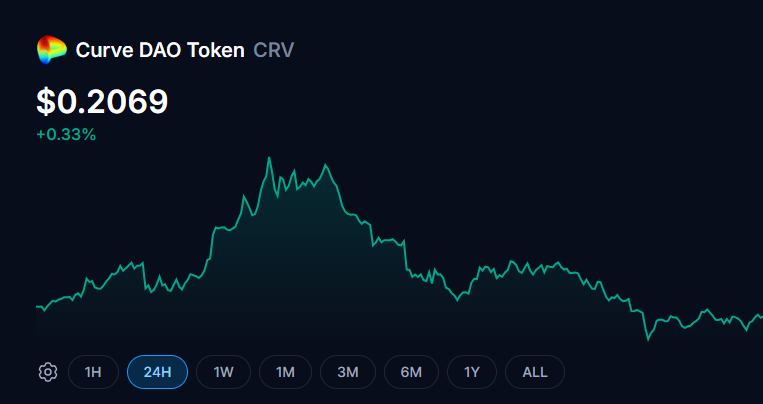
- Current CRV price is approximately $0.20 USD.
- Market capitalization exceeds $300 million.
- Circulating supply is around 1.52 billion CRV tokens.
- Maximum supply is approximately 3.03 billion CRV.
- Daily trading volume frequently exceeds $25 million.
The token has experienced significant volatility throughout its history. Following its launch, CRV reached an all-time high above $60, demonstrating strong speculative demand during previous cryptocurrency bull markets. However, like many digital assets, the token later experienced substantial price corrections due to broader market conditions.
Curve Finance and the DeFi Ecosystem
Curve Finance plays a crucial role in decentralized finance because it focuses on efficient trading between assets with similar values. This makes it particularly useful for:
- Stablecoin exchanges
- Yield farming strategies
- Liquidity provisioning
- Cross-protocol DeFi integrations
- Institutional DeFi applications
The protocol has become a foundational layer within the broader DeFi ecosystem, often integrating with lending platforms, yield aggregators, and other decentralized applications. This extensive interoperability has contributed to the long-term relevance of both Curve Finance and CRV.
Technology Behind Curve
Curve’s success largely stems from its specialized Automated Market Maker design. Traditional AMMs can suffer from significant slippage when large trades occur. Curve addresses this challenge through mathematical optimization designed specifically for similarly priced assets.
Academic research examining decentralized exchanges frequently highlights Curve as an important innovation within AMM development. The protocol’s architecture seeks to maintain liquidity efficiency while minimizing arbitrage-related losses and improving user experience.
The governance structure also reflects broader DAO principles, enabling token holders to collectively manage protocol parameters and strategic initiatives. This decentralized governance model has become increasingly common throughout the blockchain industry.
Historical Growth and Adoption
Curve Finance launched in 2020 during the rapid expansion of decentralized finance. The protocol quickly attracted liquidity due to its efficient stablecoin trading capabilities.
Several factors contributed to CRV adoption:
- Growing demand for decentralized exchanges
- Expansion of stablecoin usage
- Yield farming incentives
- DAO governance participation
- Integration with major DeFi platforms
As DeFi matured, Curve established itself as one of the sector’s leading protocols. The introduction of CRV governance further strengthened community participation and ecosystem engagement.
Advantages of CRV
Strong DeFi Presence
Curve remains one of the most recognized protocols in decentralized finance, giving CRV a strong ecosystem foundation.
Governance Utility
Token holders gain direct influence over protocol development and reward allocation.
Liquidity Incentives
CRV rewards help attract liquidity providers, enhancing platform functionality.
Established Reputation
Curve has maintained relevance through multiple market cycles, demonstrating resilience within the evolving cryptocurrency industry.
Risks and Challenges
Like all cryptocurrencies, CRV carries risks that investors should consider:
Market Volatility
CRV has experienced significant price fluctuations throughout its history.
Regulatory Uncertainty
Changes in cryptocurrency regulations may affect DeFi platforms and governance tokens.
Competition
The DeFi sector includes numerous competing exchanges and liquidity protocols.
Protocol Risks
Smart contract vulnerabilities, governance disputes, or ecosystem disruptions could affect long-term performance.
Future Outlook
The future of Curve DAO Token depends heavily on the continued growth of decentralized finance. Several developments could support long-term adoption:
- Expansion of stablecoin markets
- Increased institutional participation in DeFi
- Cross-chain interoperability solutions
- Enhanced governance mechanisms
- Greater protocol integrations
As decentralized finance evolves, governance tokens like CRV may continue playing a vital role in community-driven protocol management. The token’s value proposition remains closely linked to the success and utilization of Curve Finance itself.
Conclusion
Curve DAO Token (CRV) is a leading governance token within the decentralized finance ecosystem. Powered by Curve Finance, the token enables governance participation, liquidity incentives, staking opportunities, and community-driven protocol management. Its association with one of the most established stablecoin-focused decentralized exchanges has helped maintain its relevance in the highly competitive DeFi landscape.
Although CRV faces challenges including market volatility, regulatory uncertainty, and increasing competition, it continues to represent an important component of the broader decentralized finance movement. As blockchain technology and DeFi adoption expand, Curve DAO Token may remain a significant asset for users seeking exposure to decentralized governance and liquidity infrastructure.
