


Cosmos (ATOM) is one of the most influential blockchain ecosystems in the cryptocurrency industry. Often referred to as the “Internet of Blockchains,” Cosmos was designed to solve one of the biggest challenges facing blockchain technology: interoperability. While many blockchain networks operate independently and cannot easily communicate with one another, Cosmos provides a framework that enables different blockchains to exchange data, assets, and information securely.
Since its launch, Cosmos has grown into a large ecosystem that supports hundreds of blockchain projects, decentralized applications (dApps), decentralized finance (DeFi) protocols, and infrastructure solutions. Its technology stack, including the Cosmos SDK, CometBFT consensus engine, and Inter-Blockchain Communication (IBC) protocol, has become a popular choice for developers building scalable and customizable blockchain networks.
This article explores Cosmos, its architecture, ecosystem, ATOM token, key technologies, use cases, benefits, challenges, and future prospects.
What Is Cosmos (ATOM)?
Cosmos is a decentralized network of independent blockchains that can communicate and exchange value with one another. The project aims to eliminate the isolation of blockchain networks by creating an interconnected ecosystem where different chains remain sovereign while still interacting seamlessly.
The Cosmos ecosystem is powered by the Cosmos Hub, the first blockchain launched within the network. The native cryptocurrency of the Cosmos Hub is ATOM, which plays a central role in staking, governance, and network security.
Cosmos was established in 2016 and has since evolved into one of the leading blockchain infrastructures for interoperability and scalability. Today, the ecosystem includes more than 150 chains and secures tens of billions of dollars in digital assets.
The Vision Behind Cosmos
The primary vision of Cosmos is to create a connected blockchain ecosystem where independent networks can exchange information without relying on centralized intermediaries.
Traditional blockchains often operate as isolated systems. Bitcoin, Ethereum, and many other networks have historically struggled to communicate directly with one another. Cosmos addresses this issue by introducing a framework that allows different blockchains to interact while maintaining their independence.
This concept has earned Cosmos the nickname “Internet of Blockchains.” Similar to how the internet connects different computer networks globally, Cosmos aims to connect multiple blockchain networks into a unified ecosystem.
How Cosmos Works
Cosmos Hub
The Cosmos Hub serves as the central blockchain within the Cosmos ecosystem. It acts as a coordination layer that facilitates communication and asset transfers between connected blockchains, often referred to as zones.
The Hub maintains network security and enables seamless movement of digital assets across different chains through the IBC protocol. Although many chains can function independently, the Cosmos Hub remains a key component of the broader ecosystem.
Zones
Zones are independent blockchains connected to the Cosmos Hub. Each zone can have its own governance model, token economics, validators, and applications while remaining interoperable with other chains in the network.
This architecture allows developers to create specialized blockchains optimized for specific use cases without sacrificing connectivity.
Inter-Blockchain Communication (IBC)
One of Cosmos’s most significant innovations is the IBC Protocol. IBC allows different blockchains to exchange data and assets securely without requiring centralized bridges or intermediaries.
The protocol is often compared to TCP/IP for blockchains because it provides a standardized communication layer that enables interoperability across multiple networks.
Key Technologies Behind Cosmos
Cosmos SDK
The Cosmos Software Development Kit (SDK) is a modular framework that allows developers to build custom blockchain applications quickly and efficiently. It simplifies blockchain development by providing reusable modules and tools.
Developers can customize various aspects of their blockchain, including governance, staking, token issuance, and transaction processing.
CometBFT Consensus
Previously known as Tendermint Core, CometBFT is the consensus mechanism used throughout the Cosmos ecosystem. It provides fast transaction finality, strong security, and high throughput.
The consensus engine is based on Byzantine Fault Tolerance (BFT), enabling reliable performance even when some network participants behave maliciously.
Cosmos EVM
Cosmos also supports Ethereum compatibility through Cosmos EVM, allowing developers to deploy Solidity smart contracts while benefiting from Cosmos interoperability and performance.
The Role of ATOM Token
ATOM is the native token of the Cosmos Hub and serves several important functions.
Staking
ATOM holders can stake their tokens to help secure the network. Validators process transactions and maintain blockchain integrity, while delegators can stake their ATOM with validators to earn rewards.
Governance
ATOM holders participate in network governance by voting on proposals that affect the future direction of the Cosmos Hub. This governance system helps maintain decentralization and community involvement.
Transaction Fees
ATOM can also be used to pay transaction fees within the Cosmos Hub ecosystem. These fees help support network operations and reduce spam transactions.
Cosmos Ecosystem Growth
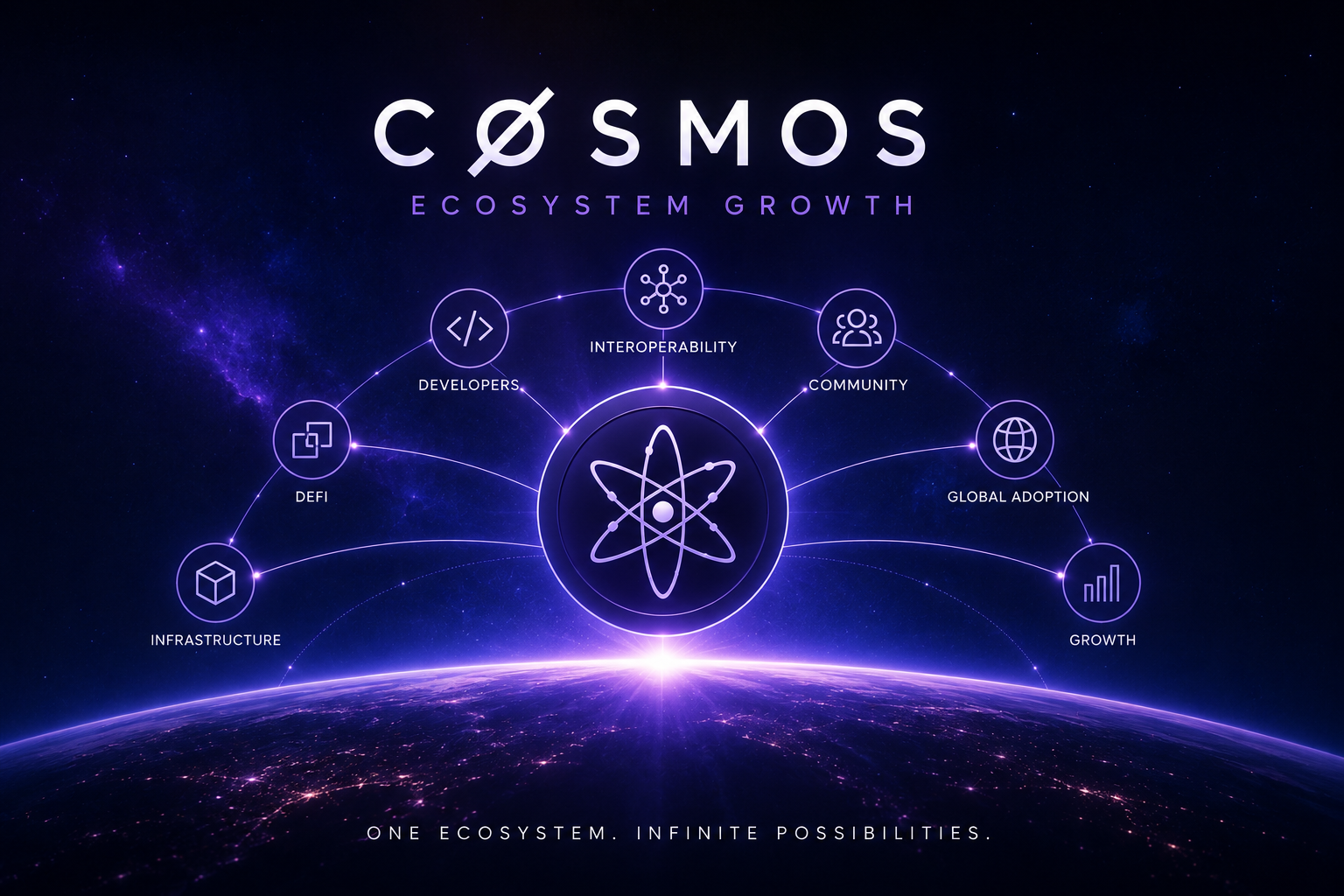
The Cosmos ecosystem has expanded significantly over the years and includes numerous prominent blockchain projects.
Some well-known projects connected to the Cosmos ecosystem include:
- Osmosis
- Celestia
- Injective
- Sei
- Axelar
- Noble
- Neutron
- Saga
- Mantra
These projects leverage Cosmos technology to create specialized blockchain solutions while maintaining interoperability through IBC.
The ecosystem now supports over 150 chains and secures approximately $70 billion in assets, highlighting its growing influence within the blockchain industry.
Advantages of Cosmos
Interoperability
The most significant advantage of Cosmos is its ability to connect different blockchain networks. Through IBC, assets and information can move seamlessly between chains.
Scalability
Rather than forcing all applications onto a single blockchain, Cosmos allows multiple blockchains to operate simultaneously. This approach improves scalability and reduces congestion.
Sovereignty
Projects built with Cosmos retain full control over their blockchain, including governance, tokenomics, and infrastructure decisions.
Developer-Friendly Environment
The Cosmos SDK simplifies blockchain development, enabling teams to launch customized networks more efficiently.
High Performance
Cosmos technology is capable of supporting high transaction throughput with rapid settlement times, making it suitable for enterprise and financial applications.
Challenges Facing Cosmos
Despite its strengths, Cosmos faces several challenges.
Competition remains intense, with projects such as Ethereum, Polkadot, Avalanche, and other interoperability-focused ecosystems seeking to capture market share.
Additionally, maintaining consistent economic value for the ATOM token has been a topic of discussion within the community. Various initiatives and tokenomics improvements have been proposed to strengthen ATOM’s long-term utility and value proposition.
Like all blockchain projects, Cosmos must also continue improving security, adoption, and developer engagement to remain competitive.
Cosmos Use Cases
Decentralized Finance (DeFi)
Many Cosmos-based projects focus on decentralized exchanges, lending platforms, and liquidity protocols. Interoperability allows users to move assets across chains efficiently.
Cross-Chain Asset Transfers
IBC enables secure movement of tokens between blockchain networks, reducing dependence on traditional bridges.
Enterprise Blockchain Solutions
Cosmos technology is increasingly being used for tokenization, payments, stablecoins, and institutional blockchain infrastructure.
Government and Financial Systems
The Cosmos framework offers customizable digital ledger solutions that can support future government and financial applications requiring scalability, compliance, and interoperability.
Current Market Position of ATOM
According to CoinMarketCap, ATOM remains one of the leading cryptocurrencies in the blockchain interoperability sector. The token has a circulating supply of over 526 million ATOM and continues to serve as the backbone of the Cosmos Hub ecosystem.
Although cryptocurrency markets remain volatile, Cosmos continues to maintain strong relevance due to its extensive developer community and growing ecosystem of interconnected chains.
The Future of Cosmos
The future of Cosmos centers on expanding interoperability, enhancing network performance, and improving the utility of ATOM.
Recent ecosystem discussions have focused on strengthening ATOM tokenomics, improving validator incentives, expanding adoption of the Cosmos Stack, and increasing participation in governance initiatives.
As blockchain adoption grows, interoperability is expected to become increasingly important. Cosmos is well-positioned to benefit from this trend because its entire architecture is designed around connecting diverse blockchain networks.
Conclusion
Cosmos has established itself as one of the most innovative blockchain ecosystems by tackling the critical challenge of interoperability. Through technologies such as the Cosmos SDK, CometBFT, and the IBC protocol, the project enables independent blockchains to communicate, exchange assets, and operate efficiently within a connected ecosystem.
The Cosmos Hub and ATOM token remain central to this vision, providing governance, security, and coordination for a growing network of chains. With more than 150 connected blockchains, strong developer adoption, and continued innovation, Cosmos continues to play a major role in shaping the future of decentralized networks.
