


Hedera is one of the most unique distributed ledger networks in the blockchain and Web3 ecosystem. Unlike many traditional blockchain platforms, Hedera uses the Hashgraph consensus algorithm, which was designed to provide high-speed transactions, strong security, fairness, and low-cost operations. The network is governed by the Hedera Council, a group of globally recognized organizations that oversee network governance, technology direction, treasury management, and strategic development.
As blockchain adoption continues to grow across industries such as finance, supply chain management, healthcare, artificial intelligence, and digital identity, Hedera has positioned itself as an enterprise-focused platform that prioritizes trust, compliance, scalability, and sustainability. Its native cryptocurrency, HBAR, powers transactions, staking, and network security while enabling developers and businesses to build decentralized applications (dApps) efficiently.
This article explores Hedera’s technology, governance model, use cases, advantages, and the important role of the Hedera Council in maintaining one of the most institutionally governed public distributed ledger networks in the world.
What Is Hedera?
Hedera is a public distributed ledger network built to support decentralized applications, tokenization, smart contracts, and secure data transactions. Unlike conventional blockchain networks that process transactions in sequential blocks, Hedera utilizes the Hashgraph consensus mechanism, which allows transactions to be confirmed quickly while maintaining security and fairness.
The network provides developers with several core services, including:
- Smart Contracts
- Token Service
- Consensus Service
- File Service
These services enable businesses and developers to create applications ranging from decentralized finance (DeFi) solutions to enterprise data management systems.
Hedera describes itself as a fully open-source, proof-of-stake network designed to deliver enterprise-grade performance while remaining accessible to developers worldwide.
Hashgraph Technology
One of Hedera’s most distinctive features is its Hashgraph consensus algorithm, invented by Dr. Leemon Baird.
Hashgraph differs significantly from traditional blockchain architectures. Instead of grouping transactions into blocks, Hashgraph uses a mechanism often described as “gossip about gossip” combined with virtual voting. This allows network participants to rapidly share transaction information and reach consensus efficiently.
Key Benefits of Hashgraph
Faster Performance
Hashgraph enables high transaction throughput and near-instant finality compared to many conventional blockchain systems. Hedera reports transaction finality in just a few seconds.
Fair Transaction Ordering
Transactions are ordered using consensus timestamps, reducing the risk of manipulation and front-running.
Strong Security
The network is designed to provide enterprise-grade security suitable for regulated industries and mission-critical applications.
Scalability
Hashgraph can process large numbers of transactions efficiently, making it attractive for large-scale commercial deployments.
The Role of HBAR
HBAR is the native cryptocurrency of the Hedera ecosystem.
It serves multiple functions across the network:
Transaction Fees
Users pay transaction fees in HBAR whenever they interact with network services. Hedera’s fees are designed to remain predictable through USD-based pricing mechanisms.
Network Security
HBAR supports the proof-of-stake security model that helps protect the network from malicious activities.
Staking
Token holders can participate in staking mechanisms that contribute to network security and decentralization.
Utility Across Applications
HBAR is utilized within decentralized applications, tokenized assets, NFT ecosystems, and enterprise solutions operating on Hedera.
What Is the Hedera Council?
The Hedera Council is a governing body composed of leading global organizations that oversee the development and operation of the Hedera network. This governance model distinguishes Hedera from many other public blockchain projects.
The Council’s primary mission is to ensure trust, security, transparency, and long-term sustainability across the network. Members collectively make decisions regarding software upgrades, treasury management, pricing models, network policies, and strategic direction.
Unlike many decentralized projects where governance can become concentrated among a small number of stakeholders, Hedera’s structure aims to distribute authority among respected institutions from different sectors and regions.
Governance Structure of the Hedera Council
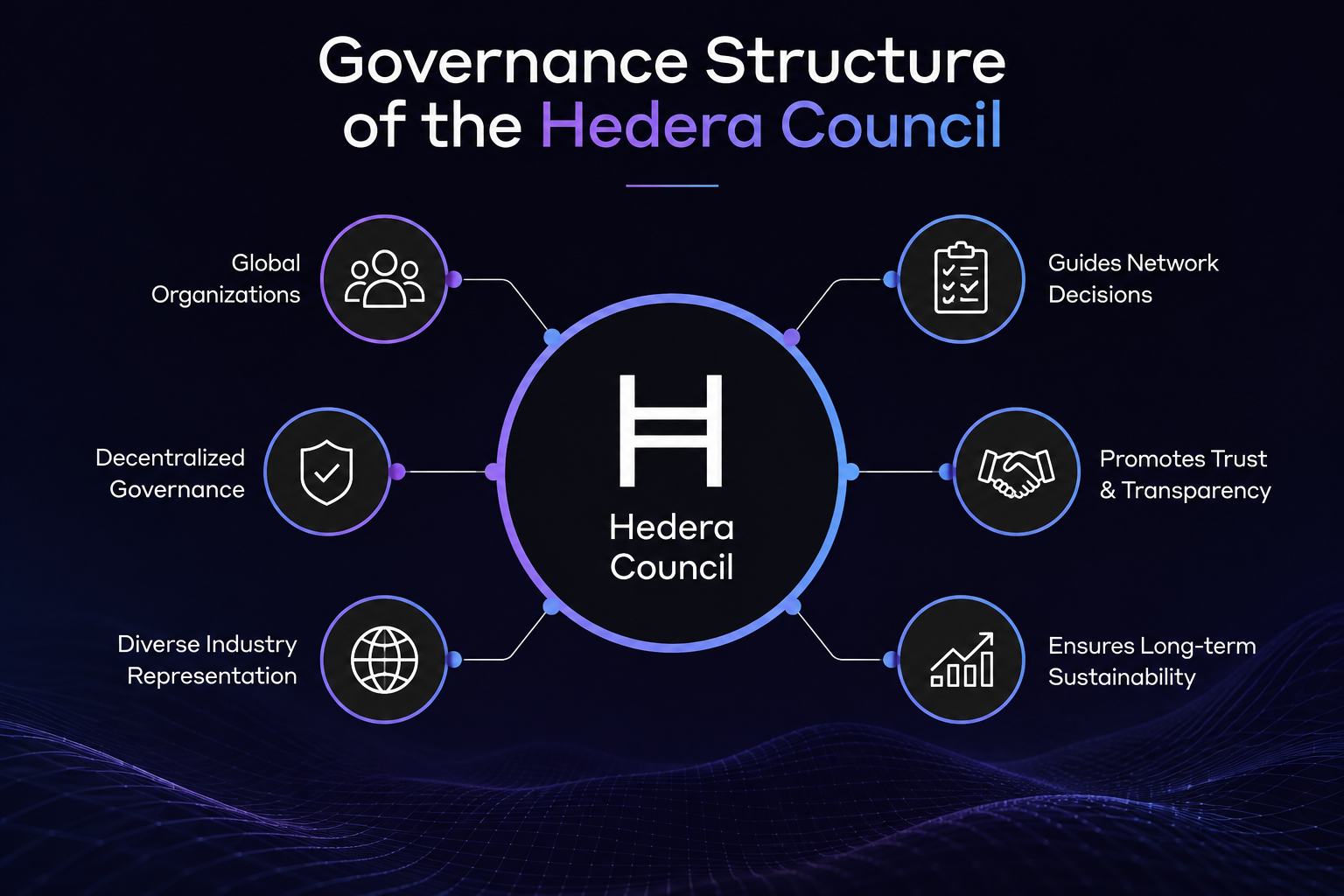
The governance framework is designed to promote decentralization while maintaining enterprise accountability.
Equal Voting Rights
Every Council member receives equal voting power regardless of size or influence. This helps prevent any single organization from dominating network decisions.
Term Limits
Council members generally serve limited terms, encouraging fresh perspectives and reducing long-term concentration of power. Most members can serve up to two consecutive three-year terms.
Diverse Membership
The Council includes organizations from numerous industries and geographic regions, including technology, telecommunications, finance, legal services, academia, and consulting.
Public Transparency
Council decisions and meeting minutes are publicly documented, supporting accountability and openness.
Major Organizations Within the Hedera Council
The Hedera Council includes many internationally recognized organizations from different industries.
Examples of participating organizations include:
- IBM
- Dell Technologies
- Deutsche Telekom
- Tata Communications
- Ubisoft
- LG
- Standard Bank
- Nomura
- Wipro
- Chainlink Labs
- Hitachi
- London School of Economics
- IIT Madras
These organizations contribute expertise, governance oversight, and strategic guidance to the network.
The Council structure is intentionally designed to represent multiple industries and geographic regions to strengthen decentralization and resilience.
Hedera Council Committees
The Council operates through specialized committees that focus on key aspects of network governance.
Technical Steering & Product Committee
This committee oversees technology development, network functionality, security improvements, and product roadmaps.
Network Utilization Committee
Focused on identifying growth opportunities, supporting use cases, and encouraging broader adoption of Hedera solutions.
Coin Economics & Treasury Management Committee
Responsible for treasury policies, network pricing models, staking economics, and financial sustainability.
Membership Committee
Provides guidance regarding Council membership standards and representation diversity.
Real-World Use Cases of Hedera
Hedera supports numerous enterprise and Web3 applications.
Financial Services
Banks and financial institutions use Hedera for tokenization, payments, settlement systems, and digital asset management. Recent initiatives have included tokenized securities and foreign exchange solutions.
Supply Chain Tracking
Organizations can create transparent and verifiable records for products throughout global supply chains.
Artificial Intelligence
Hedera is increasingly being promoted as infrastructure for AI systems requiring trusted, verifiable, and tamper-resistant data.
Digital Identity
The network can support identity verification systems while maintaining security and privacy.
Sustainability Initiatives
Hedera has emphasized energy efficiency and environmental sustainability compared to many traditional blockchain networks.
Advantages of Hedera
Several factors contribute to Hedera’s growing adoption.
Enterprise Governance
The Council model provides institutional oversight rarely seen in public distributed ledger networks.
Fast Finality
Transactions typically achieve consensus within seconds.
Low Transaction Costs
Predictable pricing makes the platform attractive for enterprise applications.
EVM Compatibility
Developers can build Solidity-based applications and leverage Ethereum development tools.
Regulatory Focus
Hedera emphasizes compliance and governance suitable for regulated industries.
Challenges and Criticisms
Despite its strengths, Hedera faces several challenges.
Some blockchain advocates argue that governance by major corporations may appear less decentralized than community-driven governance systems. Hedera responds by emphasizing equal voting rights, term limits, geographic diversity, and transparency.
Additionally, competition remains intense from established blockchain ecosystems such as Ethereum, Solana, Avalanche, and other smart contract platforms. Continuous innovation and ecosystem growth will be essential for long-term success.
The Future of Hedera
Hedera continues expanding its ecosystem through partnerships, enterprise adoption, tokenization initiatives, AI infrastructure projects, and developer-focused improvements. The network is also progressing toward greater decentralization through broader node participation and open-source development initiatives.
With support from globally recognized institutions and a governance model centered on accountability and stability, Hedera is positioning itself as a foundational layer for the next generation of digital infrastructure.
Conclusion
Hedera represents a distinctive approach to distributed ledger technology by combining innovative Hashgraph consensus with enterprise-grade governance. Its focus on speed, fairness, security, compliance, and sustainability has attracted attention from major organizations worldwide.
The Hedera Council serves as the backbone of this governance model, ensuring that decision-making remains transparent, decentralized, and aligned with the network’s long-term interests. Through equal voting rights, term limits, and global representation, the Council seeks to balance innovation with stability.
