



Bitcoin Crash Today – Live Update
How much did Bitcoin crash today? As of this writing, Bitcoin is down sharply from its intraday high and trading well below the range it held earlier this week.
The size of the drop only tells part of the story. According to data from Coinglass, which tracks futures liquidations across exchanges, more than $300 million in long positions were wiped out in the past 24 hours. When that happens, exchanges like Binance and Coinbase automatically close leveraged positions. Those forced sales push price lower, which triggers more liquidations. Traders call it a cascade, and it is why crashes in crypto always look so vertical.
Total crypto market cap fell with it. Altcoins bled harder than Bitcoin, which is normal. When fear hits, Bitcoin dominance goes up as traders dump altcoins for Bitcoin or for stablecoins like USDT. The Fear and Greed Index flipped from greed to fear in a matter of hours.
Prices are moving fast today. Before you make any move, check live price on CoinMarketCap and live liquidation data on Coinglass. This article will be updated as conditions change.
Why Did Bitcoin Crash Today? 3 Main Reasons
Bitcoin crashed today for three reasons at once: a sell-off in tech stocks that pulled risk assets down, net outflows from U.S. spot Bitcoin ETFs that created real spot selling, and a liquidation cascade where crowded longs were forced out. No single headline explains it. The combination does.
1. Macro Pressure and Stock Market Sell-Off
Bitcoin still trades like a risk asset. When the Nasdaq cracks, Bitcoin rarely holds up. Today we had a classic risk-off session. Whether it is sticky inflation, a jump in Treasury yields, or soft tech earnings, the trigger is often outside crypto entirely.
When that happens, funds de-risk everywhere. They sell stocks and they sell crypto. Because Bitcoin is the most liquid crypto asset, it gets hit first. A lot of new investors miss this connection and hunt for a crypto-only reason. Most of the time, the answer is in traditional markets.
2. Spot Bitcoin ETF Outflows and Institutional Selling
Since spot Bitcoin ETFs launched, daily ETF flows have become one of the most important drivers of price. It is simple mechanics. When ETFs see net outflows, market makers have to sell spot Bitcoin to match it.
Data from Farside Investors, which tracks daily flows for funds like BlackRock’s iShares Bitcoin Trust [IBIT] and Fidelity’s FBTC, showed net selling heading into today. One day of outflows does not end a bull market, but a cluster of them is enough to knock the price down and shake short-term confidence.
3. Massive Long Liquidations and Whale Movement
This is why the drop was so sharp. Going into the crash, funding rates were positive and elevated. Translation: too many traders were long and paying to stay long. The market was crowded on one side of the boat.
Once Bitcoin broke its short-term support, those longs started getting liquidated. On-chain data also showed a spike in whale wallets moving coins to exchanges. When large holders send BTC to Binance or Coinbase, traders assume selling is coming. That assumption alone can accelerate selling.
I have seen this exact setup in March 2023 and again in January 2024—high open interest, high funding, quiet spot buying, then a fast flush that resets everything.
Is This a Normal Correction or the Start of a Bear Market?
This looks like a normal correction inside a bigger uptrend, not the start of a bear market.
A 15% to 30% pullback in the middle of a bull run is routine for Bitcoin. It feels brutal in the moment, but it is how leverage gets cleaned out. A real bear market usually needs something structural – a major exchange collapse, a severe regulatory ban, or months of sustained ETF outflows and tightening from the Federal Reserve.
What we have today is different. It is a leverage flush. Open interest was too high, sentiment was too bullish, and the market needed to reset. The Fear and Greed Index dropping hard in one day is actually healthy. It gets weak hands out.
If you are panicking, zoom out. The hourly chart will scare you. The weekly chart will give you perspective.
How Today’s Bitcoin Crash Impacted the Crypto Market
When Bitcoin falls fast, everything else falls faster. That played out again today.
Ethereum, Solana, and other large caps dropped a larger percentage than BTC. That happens because traders rotate into Bitcoin or into dollars during fear, which pushes Bitcoin dominance up and altcoins down.
DeFi felt it too. A lot of DeFi loans use ETH or BTC as collateral. When collateral value drops, those loans get liquidated automatically by smart contracts. You also see stablecoin dominance rise, which is another sign of flight to safety.
New investors often expect their altcoins to hold up even if Bitcoin dips only a few percent. They rarely do. Altcoins carry a beta to Bitcoin. When BTC sneezes, they catch a cold.
Bitcoin Technical Analysis – Key Levels to Watch Next
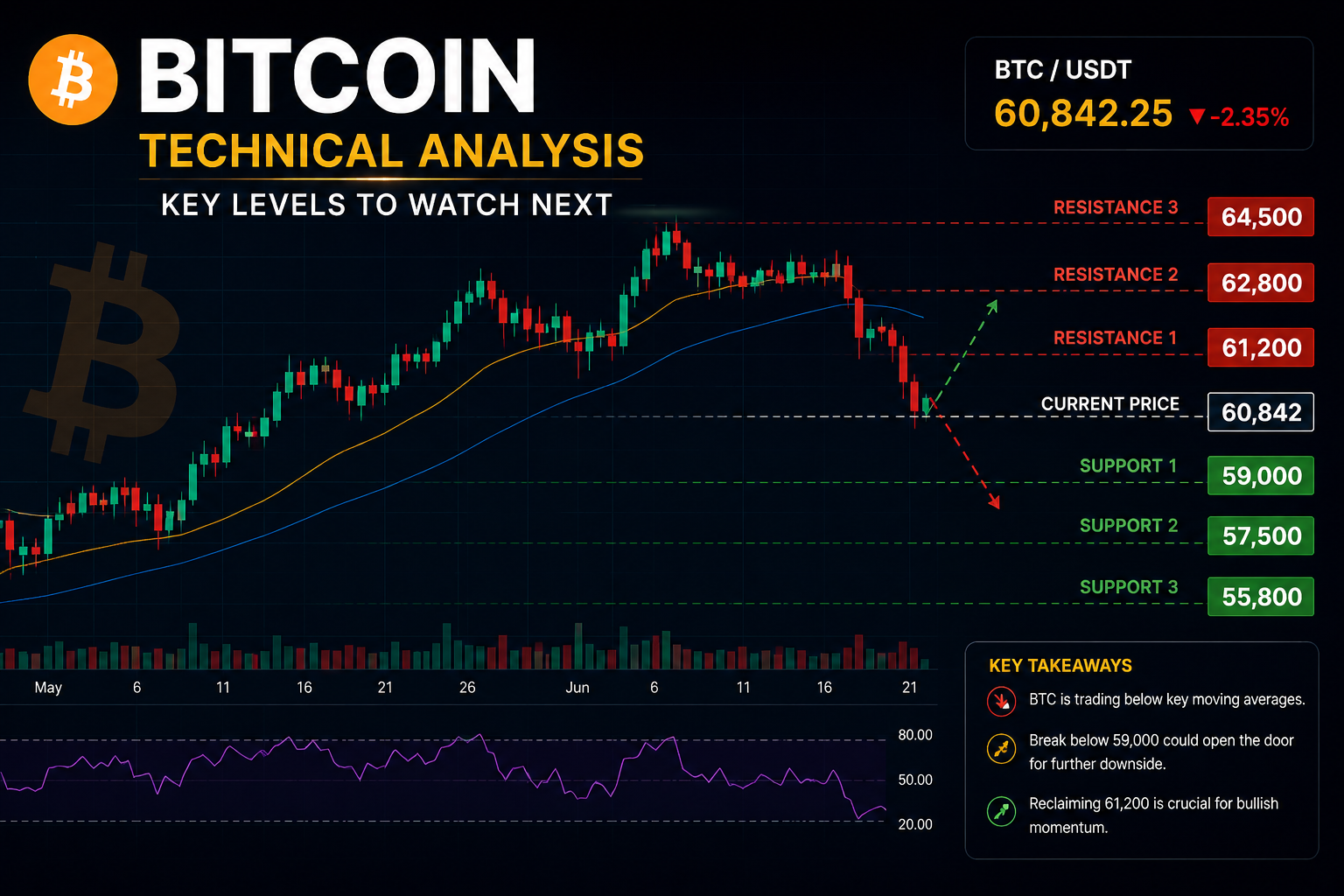
The immediate question is whether Bitcoin can reclaim the level it just lost. If it reclaims quickly and turns that breakdown into support again, today becomes a wick – a liquidity grab that trapped sellers.
If it cannot, the next area to watch is the cluster around the 50-day and 100-day moving averages. Those levels have acted as support during corrections throughout this cycle.
Two things are working in favor of a bounce. First, funding rates have reset from highly positive to neutral, even slightly negative on some exchanges. That means the market is no longer crowded long. Second, volume spiked during the drop. High volume capitulation often marks at least a short-term bottom.
Do not rush to buy the first green candle. That is how people get caught in a dead-cat bounce. Wait for a higher low to form on the one-hour chart. Declining selling volume on down moves and rising volume on up moves is often the earliest sign sellers are exhausted.
What Should You Do Now?
What you should do depends entirely on your timeframe. There is no universal move in a crash.
If You Are a Short-Term Trader
Preservation comes first. Do not add high leverage right after a liquidation cascade. Volatility stays extreme in both directions and you can get stopped out on both sides. Respect your stop loss and avoid revenge trading. Most traders lose more trying to win back what they lost in the crash than they lost in the crash itself.
If You Are a Long-Term Investor
Long-term holders play a different game. If your thesis has not changed, a single day does not force you to sell. Many experienced holders use dollar-cost averaging during fear instead of all-in bets. If you are not actively trading, your Bitcoin should not be sitting on an exchange anyway. Self-custody in a cold wallet is still the safest option for long-term holding.
Either way, do not make big decisions based on social media panic. Verify price, liquidations, and ETF flows from official sources before you act.
Will Bitcoin Recover After Today’s Crash?
Bitcoin has recovered from every sharp crash in its history, though that does not guarantee it will this time.
Over the next 24 to 72 hours, two things will decide the bounce. Does the Nasdaq stabilize, and do spot Bitcoin ETF flows turn back to net inflows? If both happen, Bitcoin tends to recover quickly. If equities keep selling, crypto will likely stay heavy.
History suggests these leverage flushes do not lead to an immediate V-shaped recovery. What you usually get is a period of choppy, sideways consolidation, then a slow grind back up. That consolidation is actually constructive. It builds a stronger base.
Watch for that shift – lower volume on dips, higher volume on rallies. That is often how bottoms form.
Conclusion
Today was a textbook leverage flush. A soft day in stocks, net selling from spot Bitcoin ETFs, and a crowded long trade led to a cascade of liquidations that pushed Bitcoin down hard. Altcoins fell harder, fear spiked, and funding reset. While painful for short-term traders, the structure looks more like a correction that clears excess risk than a fundamental breakdown. Track ETF flows, stock market direction, and key support levels over the next few days before deciding whether the worst is over.
