


Compound Finance, one of the founding fathers of decentralized finance, is attempting the most radical reset in its seven-year history.
On Monday, the decentralized lending protocol announced it had replaced its leadership team and approved a record $52 million annual budget in a decisive pivot toward institutional capital. The move comes after a brutal drawdown: the total value locked (TVL) on Compound has collapsed to $1.2 billion from an all-time high of $12 billion in September 2021.
The protocol, which pioneered on-chain lending in 2018 and has processed roughly $480 billion in cumulative deposits and borrows since inception, said its future will be built on three pillars: real-world assets (RWAs), deep partner integrations, and credit infrastructure designed for traditional financial markets.
It’s a clear admission that the retail-driven, yield-farming era that made Compound famous is over — and that the next phase of DeFi will be won by protocols that can speak the language of banks, funds, and risk committees.
From DeFi Darling to Underdog: Why Compound Had to Change
Compound’s story is DeFi history. When founder Robert Leshner launched Compound v2, it introduced a simple, revolutionary idea: let anyone deposit crypto and earn yield, or post collateral and borrow, all without an intermediary. The launch of the COMP governance token in 2020 kicked off “DeFi Summer” and the liquidity mining boom.
But innovation didn’t stand still. Competitors, most notably Aave, out-executed on multi-chain expansion, risk management, and product velocity. Today, Aave holds more than $14.8 billion in TVL, more than 11 times Compound’s size, according to DeFiLlama data. Compound’s decline mirrors the broader DeFi contraction. Total value locked across the sector has fallen by more than a third since the start of 2026 to roughly $70 billion, according to industry trackers.
Yet the long-term forecast remains massive. Standard Chartered projects the DeFi sector could reach $2.7 trillion by 2030, with tokenized real-world assets emerging as the fastest-growing segment. Compound is betting that $52 million can buy it a seat at that table.
“Now is a great time for initiatives like these, where real capital goes toward both the structural work and the bringing in of bright minds from the institutional sphere who can explain it to a risk committee in their own language,” said Gal Stern, chief business development officer at deBridge. “That combination is what brings institutional confidence back.”
Inside the $52 Million War Chest: Where the Money Goes
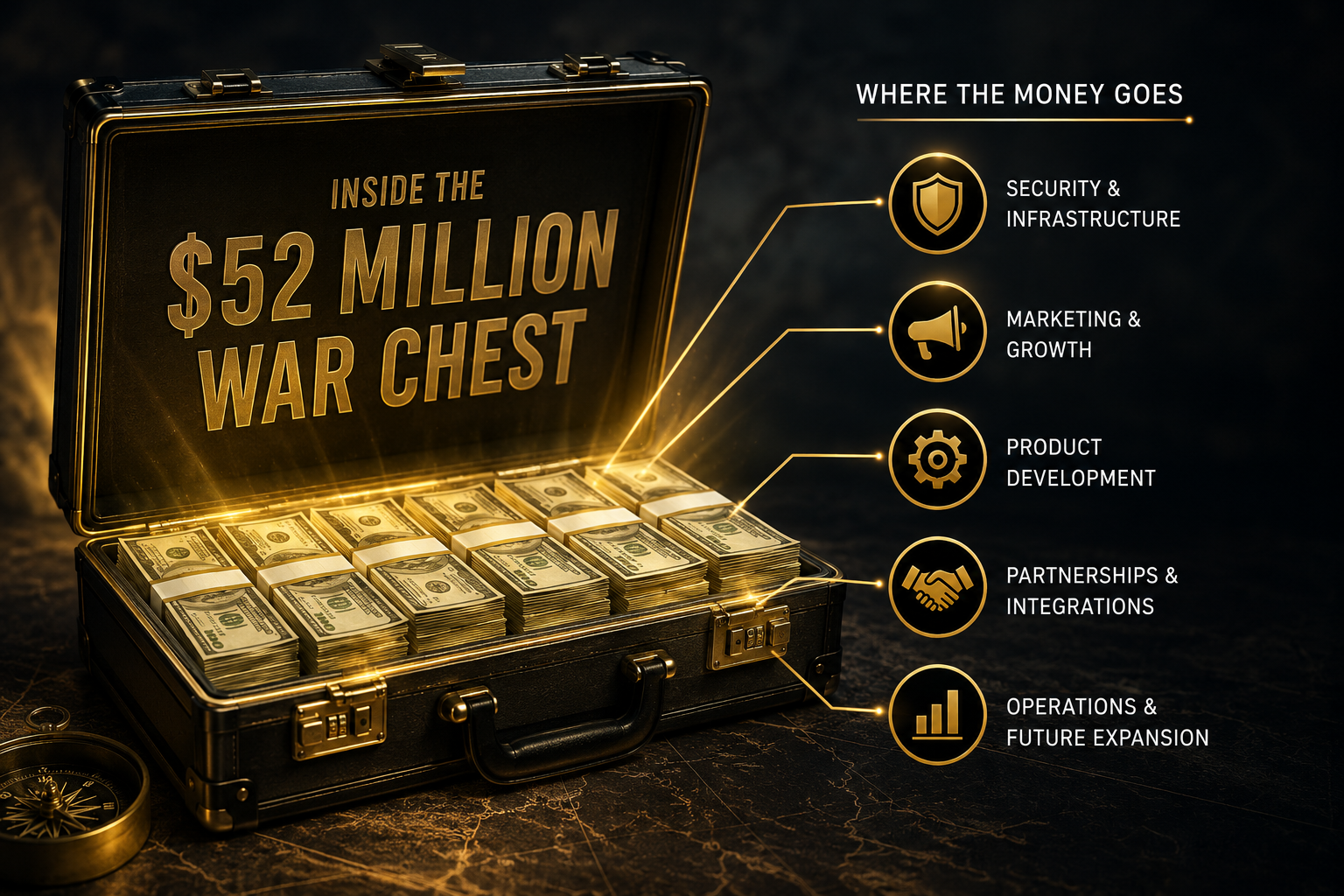
The approved budget is the largest in Compound DAO history and marks a shift from lean protocol maintenance to aggressive business development.
According to the proposal, the $52 million will be allocated across four key areas:
1. Institutional Product Development: Building compliant, permissioned lending vaults, KYC/AML layers, and credit infrastructure that can be used by custodians, prime brokers, and fintechs.
2. Real-World Asset (RWA) Integration: Onboarding tokenized Treasuries, private credit, and money-market funds as collateral. This is where Compound sees the most near-term institutional demand, as tokenized T-bills already exceed $6 billion market-wide.
3. Partner Integrations and Distribution: Paying for deep integrations with custodians like Anchorage Digital, exchanges, and wallets to make Compound a back-end yield engine rather than a front-end destination.
4. Security, Risk, and Legal: Expanding risk modeling, formal audits, and regulatory engagement — critical for institutional adoption.
Unlike previous grant programs, this budget is tied to KPIs: growth in institutional TVL, RWA origination, and active borrowing from non-crypto-native entities.
The New Leadership Team: Wall Street Meets DeFi
Compound DAO also confirmed a complete overhaul of its operational leadership, bringing in executives with direct experience scaling institutional crypto products.
The new team includes:
Christopher Donovan – Chief Operating Officer: Donovan previously served as COO at the Near Foundation, where he helped scale the NEAR ecosystem and its enterprise partnerships. He brings operational experience in managing large foundations and developer ecosystems.
His expertise in private credit and institutional loan origination is central to Compound’s new strategy. The message is clear: the protocol doesn’t need more DeFi natives; it needs people who have sold to BlackRock, BNY Mellon, and hedge funds before.
The New Playbook: RWA, Credit Infrastructure, and B2B DeFi
Compound’s new strategy is essentially a revival and expansion of Compound Treasury — the centralized service launched in 2021 that allowed fintechs to wire US dollars and earn 4% yield via USDC conversion in partnership with Fireblocks and Circle.
That product struggled to gain traction in a high-interest-rate environment where risk-free T-bills paid more than DeFi yields. The new version flips the model.
Instead of just offering yield on dollars, Compound will now allow institutions to borrow against high-quality collateral, provide white-label lending infrastructure to fintechs and banks, and use DeFi rails to settle traditional private credit.
In practice, this means a neobank could use Compound’s smart contracts to power its own lending product, or a fund could post tokenized BlackRock BUIDL or Franklin Templeton money-market tokens as collateral to borrow stablecoins instantly.
This B2B infrastructure play is less sexy than retail yield farming, but far more lucrative. Private credit and tokenized Treasuries are a $25+ billion market growing at triple digits year-over-year, while retail DeFi lending yields have compressed to low single digits.
Can Compound Catch Aave? The Road to Recovery
The challenge is immense. Aave has not only a massive TVL lead but also a live institutional product — Aave Arc — and a GHO stablecoin that is gaining traction. Other competitors like Morpho and Spark have also eaten into Compound’s market share by offering more efficient risk vaults and better incentives.
For Compound to reclaim relevance, it must do three things:
- Prove institutional product-market fit: Attract at least $500M-$1B in RWA collateral in the next 12 months.
- Re-activate the COMP token: COMP is down more than 90% from its highs. The DAO needs to show how new fee streams from institutional products accrue value back to token holders.
- Avoid the security pitfalls that have plagued DeFi this year. One major exploit would shatter the institutional confidence it is trying to rebuild.
If it succeeds, Compound could become the plumbing for a new era of finance — not the app consumers touch, but the protocol that powers the apps banks and fintechs use.
If it fails, it risks becoming a cautionary tale of a first-mover that pioneered a category but couldn’t evolve with it.
With $52 million in the treasury and a Wall Street-ready leadership team, Compound has bought itself one more shot.
