


Ethereum has become one of the most influential blockchain networks in the world, powering decentralized applications, decentralized finance (DeFi), NFTs, gaming ecosystems, and countless digital assets. At the heart of every Ethereum transaction lies a crucial concept known as Gas Ethereum. Whether you are sending ETH, swapping tokens, minting NFTs, or interacting with a smart contract, gas is what keeps the entire network running smoothly.
Many newcomers are often confused by Ethereum gas fees because they fluctuate constantly. One day, a transaction might cost only a few cents, while during periods of network congestion, the same transaction could become significantly more expensive. Understanding how gas works is essential for anyone who wants to use Ethereum efficiently and avoid unnecessary costs.
Gas serves as the pricing mechanism for computational work on Ethereum. It determines how much users pay for transactions and helps protect the network from spam, abuse, and malicious attacks. Without gas fees, the Ethereum blockchain would struggle to maintain security and efficiency. Gas ensures that validators are compensated for processing transactions while encouraging responsible use of network resources.
This guide explores everything you need to know about Gas Ethereum, including how gas fees are calculated, why they change, the role of EIP-1559, and strategies for reducing transaction costs.
Gas Ethereum
Gas Ethereum refers to the unit used to measure the computational effort required to execute operations on the Ethereum blockchain. Every action performed on Ethereum consumes computational resources. These resources must be paid for through gas fees.
Think of gas as fuel for a vehicle. Just as a car requires fuel to move, Ethereum transactions require gas to be processed. The more complex the operation, the more gas it consumes.
For example, sending ETH from one wallet to another requires less computational work than executing a sophisticated smart contract, participating in DeFi protocols, or minting an NFT. Consequently, complex transactions generally require more gas.
Gas is not a separate cryptocurrency. Instead, gas fees are paid using ETH, Ethereum’s native cryptocurrency. The cost of gas is usually expressed in Gwei, which is a smaller denomination of ETH equal to one-billionth of an ETH.
Why Ethereum Uses Gas Fees
Ethereum’s gas system serves several important purposes that contribute to the network’s security and functionality.
First, gas prevents spam attacks. Since every transaction requires payment, malicious actors cannot flood the network with unlimited transactions without incurring significant costs.
Second, gas ensures fair allocation of computational resources. Users who consume more network resources pay higher fees, creating a balanced and efficient ecosystem.
Third, gas compensates validators who verify and process transactions. Validators dedicate computational power and resources to maintain blockchain integrity, and gas fees help reward their participation.
Without gas fees, Ethereum would be vulnerable to abuse, congestion, and inefficient use of its computational infrastructure.
How Ethereum Gas Fees Work
Understanding how gas fees are calculated is crucial for anyone using Ethereum regularly.
Every transaction requires a specific amount of gas units depending on the complexity of the operation. The total transaction cost is determined by multiplying the gas consumed by the gas price.
In simple terms:
Gas Fee = Gas Used × Gas Price
A basic ETH transfer typically requires 21,000 gas units. More advanced interactions involving decentralized applications (dApps), NFT marketplaces, and smart contracts consume substantially more gas.
For example, if a transaction uses 21,000 gas units and the effective gas price is 10 Gwei, the final fee will depend on the multiplication of these values.
Because network demand changes continuously, gas prices can fluctuate throughout the day.
The Role of Gwei in Ethereum Gas
To understand gas fees properly, users must understand Gwei.
ETH is divisible into smaller units, much like dollars can be divided into cents. Gwei is one of the most commonly used units for measuring gas prices.
One Gwei equals:
1,000,000,000 Wei
Since gas prices are usually very small fractions of ETH, expressing them in Gwei makes calculations easier and more practical.
Wallets and blockchain explorers often display gas prices in Gwei, allowing users to estimate transaction costs before confirming transactions.
Ethereum Gas After EIP-1559
One of the most significant changes in Ethereum’s history came through EIP-1559, which transformed how gas fees are calculated.
Before EIP-1559, Ethereum used a bidding system where users competed against one another by offering higher gas prices. This often led to unpredictable and excessively high fees.
EIP-1559 introduced a more structured approach that divides fees into two components:
Base Fee
The base fee is automatically determined by the Ethereum protocol according to network demand. Every transaction must pay this fee to be considered valid.
An important feature of the base fee is that it is burned, meaning it is permanently removed from circulation rather than paid to validators. This mechanism contributes to Ethereum’s economic model by reducing ETH supply over time.
Priority Fee
The priority fee, often called a tip, is paid directly to validators.
Users can increase their priority fee if they want faster transaction confirmation during periods of high network congestion. Validators naturally prioritize transactions offering higher tips.
Max Fee
Users may also specify a maximum fee they are willing to pay.
If actual network conditions require less than the specified maximum, unused funds are refunded to the user. This helps prevent overpayment and improves fee predictability.
Why Gas Fees Increase and Decrease
One of the most common questions among Ethereum users is why gas fees fluctuate so dramatically.
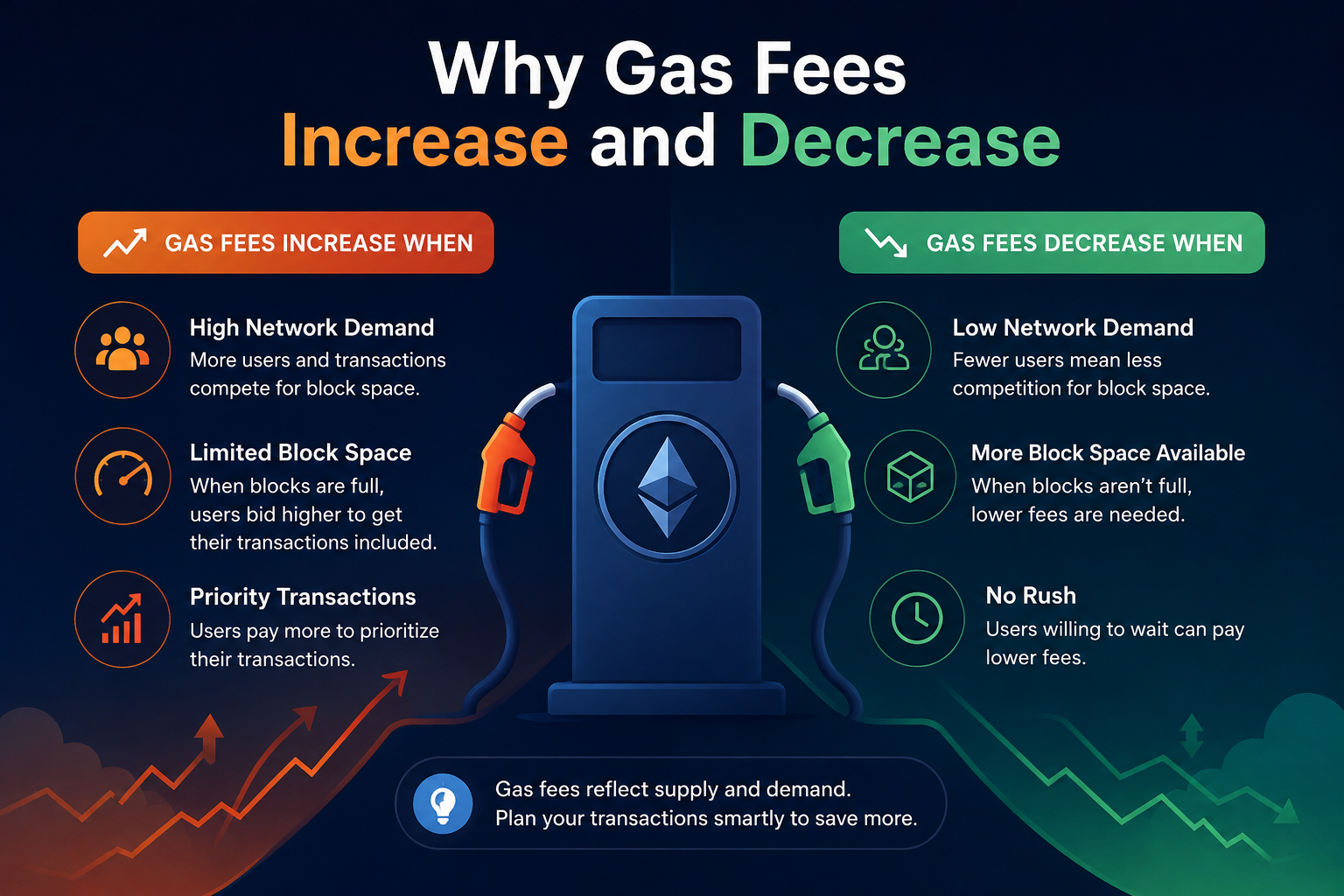
The answer lies in supply and demand.
Ethereum block space is limited. When large numbers of users attempt to submit transactions simultaneously, competition for block space increases. This drives gas fees higher.
Several events can trigger gas fee spikes:
NFT Launches
Popular NFT collections often attract thousands of buyers at the same time. This sudden surge in activity increases competition for transaction inclusion.
DeFi Trading Activity
Periods of high volatility frequently lead to increased activity on decentralized exchanges, lending protocols, and yield farming platforms, causing gas prices to rise.
Token Airdrops
Major token launches and airdrops often generate intense demand, resulting in temporary congestion.
Market Volatility
Rapid price movements encourage traders to move assets quickly, increasing transaction volume across the network.
Conversely, when network activity decreases, gas fees tend to fall because there is less competition for available block space.
Gas Limits Explained
Another important concept is the gas limit.
A gas limit represents the maximum amount of gas a user is willing to spend on a transaction. Every Ethereum operation requires a certain amount of gas, and users must specify a limit sufficient to complete the transaction.
For a standard ETH transfer, 21,000 gas units are usually enough.
However, smart contract execution, token swaps, and complex blockchain transactions may require significantly higher gas limits.
If the gas limit is set too low, the transaction may fail before completion. In such cases, the user may still pay for computational work already performed by the network.
Therefore, accurately estimating gas limits is essential for successful transactions.
How Gas Powers Smart Contracts
Ethereum is much more than a payment network. It functions as a programmable blockchain capable of running sophisticated smart contracts.
Every function executed within a smart contract consumes gas. More complex operations require more computational resources and therefore higher gas consumption.
For example, interacting with:
Decentralized Finance (DeFi) platforms,
NFT marketplaces,
Blockchain games,
DAO governance systems,
and Web3 applications
requires smart contract execution and corresponding gas payments.
Gas creates an economic incentive that prevents developers from creating inefficient code while ensuring that computational resources remain fairly distributed across the network.
Ethereum Gas and Network Security
Gas is fundamental to Ethereum’s security architecture.
Without gas fees, attackers could attempt to overload the network with millions of transactions or deploy malicious smart contracts containing endless computational loops.
Because every computational operation carries a cost, attackers must spend substantial resources to perform such attacks.
This economic barrier significantly reduces the likelihood of network abuse and helps maintain blockchain stability.
Gas effectively transforms computational resources into economic resources, creating strong incentives for responsible network usage.
Layer 2 Solutions and Lower Gas Costs
As Ethereum adoption has grown, developers have introduced Layer 2 scaling solutions to reduce gas fees and improve scalability.
Layer 2 networks process transactions outside the Ethereum mainnet while still benefiting from Ethereum’s security.
Popular Layer 2 solutions include:
Optimistic Rollups
Zero-Knowledge Rollups
Arbitrum
Optimism
Base
These technologies bundle multiple transactions together before submitting them to Ethereum, significantly reducing individual transaction costs. Ethereum’s ongoing scalability improvements continue to support lower fees and greater throughput.
How to Reduce Ethereum Gas Fees
Although users cannot directly control network congestion, several strategies can help minimize gas costs.
Monitoring network activity is often beneficial because fees tend to be lower during off-peak hours.
Using Layer 2 networks can dramatically reduce costs compared to transacting directly on the Ethereum mainnet.
Modern wallets also provide fee estimates that help users choose appropriate transaction speeds and costs.
For non-urgent transactions, selecting lower priority fees may lead to meaningful savings while still ensuring eventual confirmation.
Understanding gas dynamics enables users to optimize costs without sacrificing security or functionality.
The Future of Ethereum Gas Fees
Ethereum continues evolving through upgrades designed to improve scalability, efficiency, and user experience.
Advancements in Layer 2 ecosystems, data availability improvements, and network optimizations aim to reduce congestion while supporting broader adoption.
Although gas fees will likely continue to fluctuate according to demand, the Ethereum ecosystem is steadily becoming more efficient. Recent upgrades have already contributed to lower transaction costs on many Layer 2 platforms while preserving Ethereum’s decentralized security model.
As blockchain adoption expands globally, gas will remain a critical mechanism that balances demand, security, and network performance.
Conclusion
Gas Ethereum is the foundation that powers every transaction, smart contract, and decentralized application on the Ethereum blockchain. By measuring computational work and assigning a cost to network resources, gas ensures that Ethereum remains secure, efficient, and resistant to spam.
The introduction of EIP-1559 significantly improved fee predictability by introducing the base fee and priority fee model while also burning a portion of transaction fees. As Ethereum continues to evolve through scalability upgrades and Layer 2 innovations, users can expect improved efficiency and lower transaction costs over time.
