



The decentralized finance (DeFi) sector has once again been shaken by a major security incident. Ethereum-based lending protocol Term Finance recently suffered a devastating attack that resulted in approximately $8.5 million in losses after a malicious actor acquired enough governance voting power to gain control over key protocol vaults. Unlike traditional smart contract exploits that rely on coding vulnerabilities, this attack targeted the protocol’s governance structure, highlighting a growing threat facing decentralized applications across the blockchain ecosystem.
The incident has reignited discussions about DeFi governance security, DAO voting mechanisms, Ethereum lending protocols, and the risks associated with decentralized decision-making systems. As blockchain projects increasingly rely on community governance, attackers are finding new ways to manipulate voting systems and exploit weaknesses in governance frameworks.
This event serves as a critical reminder that even well-designed decentralized protocols can remain vulnerable if governance safeguards are insufficient. Understanding how the attack occurred, its implications for investors, and what it means for the future of decentralized finance is essential for anyone involved in the cryptocurrency industry.
What Is Term Finance?
Term Finance is a decentralized lending and borrowing platform built on the Ethereum blockchain. The protocol focuses on fixed-rate lending markets, allowing users to lend and borrow digital assets with predictable interest rates rather than relying on constantly fluctuating variable-rate models.
The platform was designed to address inefficiencies in traditional DeFi lending by creating transparent and efficient capital markets. Through its lending infrastructure, users can access liquidity while maintaining control over their assets through smart contracts.
Like many modern DeFi protocols, Term Finance incorporated a governance system that enabled token holders to participate in decision-making processes. Governance participants could vote on protocol upgrades, vault management decisions, and strategic changes designed to improve the platform.
However, the same governance mechanism that was intended to decentralize control ultimately became the protocol’s weakest point.
The $8.5 Million Governance Attack
The attack on Term Finance was not a conventional smart contract exploit. Instead, it involved a governance takeover in which the attacker accumulated enough voting power to influence and approve malicious proposals. Investigators reported that the attacker acquired governance tokens at relatively low cost before obtaining majority voting control over several strategy vaults. Once sufficient influence was secured, malicious governance actions were proposed and approved, granting the attacker effective control over vault assets.
Reports indicate that approximately 2,843 ETH and around $1.68 million in stablecoin assets were drained from affected vaults, producing total losses estimated at roughly $8.5 million. The broader lending markets of the protocol were reportedly unaffected, but the vault infrastructure suffered severe damage.
This type of attack demonstrates how governance vulnerabilities can be just as dangerous as software bugs, particularly when voting power can be concentrated in the hands of a single actor.
How Governance Voting Power Became the Weak Link
The Role of DAO Governance
Many decentralized finance protocols rely on Decentralized Autonomous Organizations (DAOs) to govern operations. Governance token holders are given voting rights that allow them to participate in protocol management.
The underlying philosophy is straightforward: instead of a centralized company making decisions, the community collectively determines the future direction of the platform.
While this model promotes decentralization, it also creates a significant challenge. If a malicious participant accumulates enough governance tokens, they can potentially influence decisions in ways that benefit themselves rather than the broader community.
Buying Influence Through Governance Tokens
In the Term Finance incident, the attacker allegedly recognized that governance tokens were available in relatively limited quantities. By strategically acquiring enough tokens, the attacker secured overwhelming voting influence over critical vaults.
Security analysts noted that the attacker gained dominant control over multiple strategy vaults and a significant share of voting power within the affected governance structure. Once control was established, malicious proposals were approved through legitimate governance processes.
This approach differs from traditional hacking because the attacker essentially used the protocol’s own governance rules against it.
Why Governance Attacks Are Difficult to Prevent
Governance attacks present unique challenges because they often follow authorized procedures. Unlike smart contract exploits that violate intended behavior, governance attacks may technically comply with protocol rules while still producing harmful outcomes.
As a result, security audits focused solely on code vulnerabilities may fail to identify governance risks before they become serious threats.
The Assets Lost During the Exploit
The attacker reportedly extracted approximately 2,843 ETH along with roughly $1.68 million in stablecoins. Following the withdrawal, portions of the stablecoin holdings were converted into DAI, making asset tracking more complex for investigators.
These stolen assets represented a substantial portion of the vault ecosystem managed by the affected governance structure. Estimates suggest that nearly two-thirds of the vaults’ total value was compromised during the incident.
Although the protocol’s core lending operations remained functional, the losses significantly impacted user confidence and raised concerns about governance security across the broader DeFi industry.
Why This Incident Matters for Ethereum DeFi
Governance Risk Is Growing
For years, the DeFi industry primarily focused on protecting against smart contract vulnerabilities, flash loan attacks, and oracle manipulation exploits. However, governance attacks are becoming increasingly common.
The Term Finance incident demonstrates that attackers are evolving their strategies and targeting governance frameworks instead of software flaws.
As more protocols embrace decentralized governance, voting systems themselves are becoming high-value attack surfaces.
Investor Confidence Could Be Impacted
One of the biggest challenges facing decentralized finance is maintaining user trust.
Investors often assume that audited smart contracts provide sufficient protection. However, governance attacks reveal that protocol security extends beyond code quality.
Users must also evaluate:
Governance token distribution
Voting participation rates
Timelock protections
Emergency veto mechanisms
Community oversight procedures
Without these safeguards, protocols may remain vulnerable even when their code is technically secure.
Regulatory Attention May Increase
Major DeFi incidents frequently attract scrutiny from regulators and policymakers.
As governance-related attacks continue to occur, regulators may begin examining whether decentralized protocols have adequate controls to protect users from manipulation and abuse.
The balance between decentralization and security remains one of the most important challenges facing the industry.
Comparing Governance Attacks to Traditional DeFi Exploits
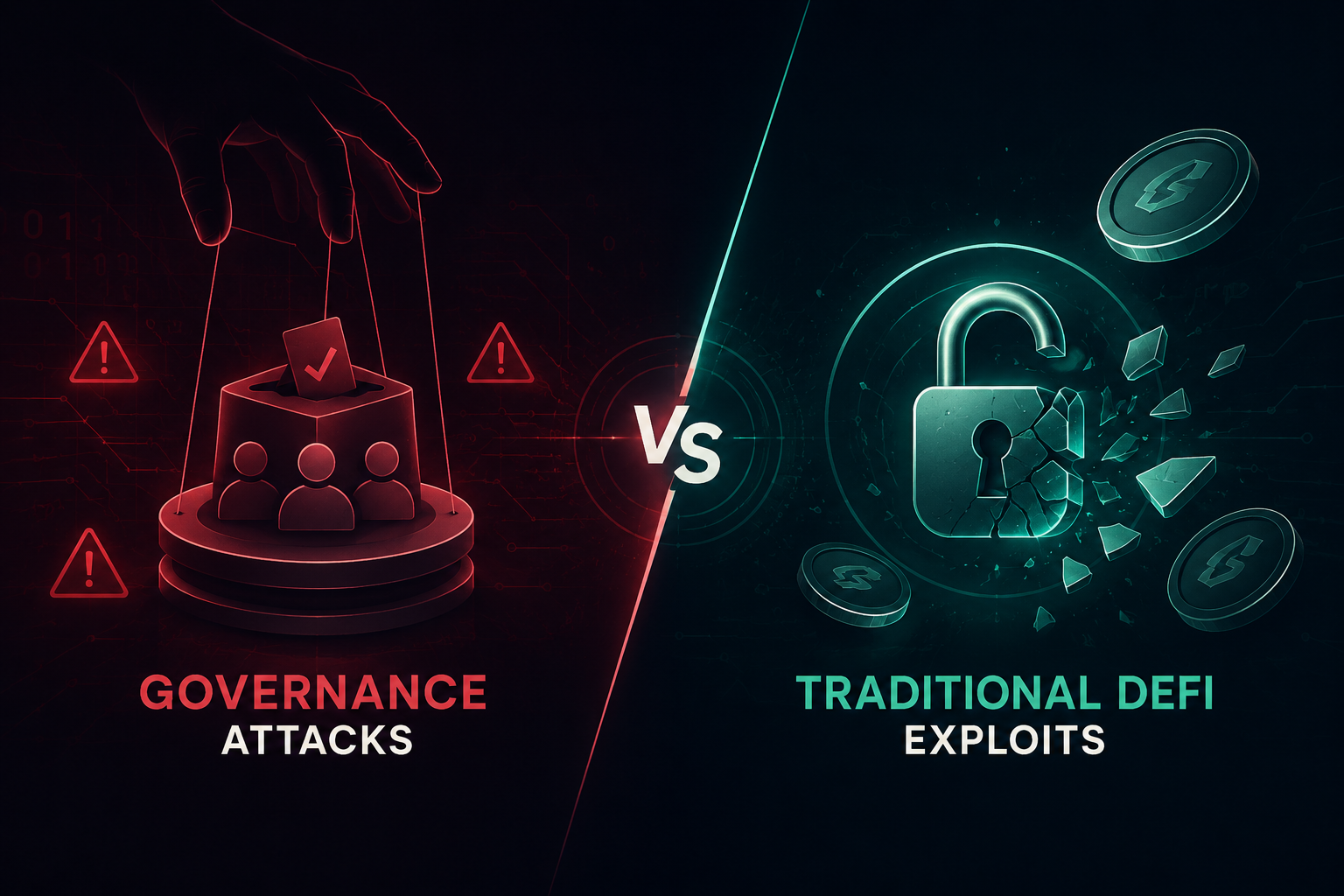
Smart Contract Exploits
Traditional attacks typically exploit coding mistakes within smart contracts. Hackers identify vulnerabilities and use them to gain unauthorized access to funds.
These attacks often involve:
Reentrancy vulnerabilities
Flash loan manipulation
Oracle attacks
Logic flaws
Developers can usually address these issues through code reviews and security audits.
Governance Exploits
Governance attacks are fundamentally different.
Instead of breaking protocol rules, attackers manipulate governance systems to gain legitimate authority. Once control is achieved, harmful actions can be approved through authorized processes.
This makes governance exploits particularly dangerous because they may not trigger conventional security alerts.
The Term Finance case serves as a textbook example of how governance control can be weaponized against a decentralized protocol.
Security Lessons for the DeFi Industry
Stronger Voting Requirements
Protocols should consider implementing stricter governance requirements before critical actions can be approved.
Measures such as higher quorum thresholds and multi-stage approval processes can reduce the risk of governance takeovers.
Longer Timelock Periods
Timelocks create delays between proposal approval and execution.
These delays provide communities with time to review decisions and respond to suspicious proposals before funds can be moved.
Decentralized Voting Distribution
Protocols should encourage broader governance participation.
When voting power becomes concentrated among a small number of participants, the risk of governance capture increases significantly.
Emergency Protection Mechanisms
Emergency veto systems and community oversight tools can help stop malicious proposals before they are executed.
Although some protection mechanisms reportedly existed within the affected governance structure, questions remain regarding why they failed to prevent the exploit.
The Broader State of DeFi Security in 2026
The Term Finance incident is part of a larger trend affecting the cryptocurrency industry.
Blockchain security researchers have reported substantial losses across the DeFi ecosystem during 2026, with Ethereum-based applications accounting for a significant portion of total exploit-related damages. Governance attacks, application-layer vulnerabilities, and protocol logic weaknesses continue to contribute to growing security concerns.
As decentralized finance expands, attackers are becoming increasingly sophisticated.
Rather than targeting only technical vulnerabilities, they are exploiting economic incentives, governance structures, and human decision-making processes.
This evolution requires protocols to adopt a more comprehensive security mindset that includes both technical and governance protections.
What Happens Next for Term Finance?
Following the exploit, the Term Finance team acknowledged the governance attack and began investigating the incident. The protocol has reportedly taken steps to address the affected vault products and governance permissions while working with security experts to assess the full impact.
The recovery process may involve:
Reconstructing governance frameworks.
Improving voting security mechanisms.
Enhancing community oversight.
Strengthening protocol risk management.
Communicating transparently with affected users.
The outcome of these efforts will likely influence how future DeFi projects design governance systems.
The Future of DeFi Governance Security
Governance has long been considered one of the defining features of decentralized finance. However, incidents like the Term Finance exploit demonstrate that governance itself can become a major vulnerability.
Future protocols may increasingly adopt hybrid approaches that combine decentralization with additional security controls. These could include reputation systems, delegated governance safeguards, dynamic voting limits, and enhanced monitoring systems.
The industry is also likely to invest more heavily in governance auditing, DAO security assessments, risk management frameworks, and on-chain monitoring solutions.
Ultimately, the success of decentralized finance depends on creating governance structures that remain both democratic and resilient against manipulation.
Conclusion
The $8.5 million loss suffered by Ethereum-based lending platform Term Finance represents one of the most significant governance-related DeFi incidents of 2026. Rather than exploiting a smart contract vulnerability, the attacker reportedly acquired enough governance voting power to control key vaults and authorize malicious actions, demonstrating the growing risks associated with decentralized governance systems.
This event highlights a critical lesson for the entire blockchain industry: security is not just about code. Governance frameworks, voting structures, token distribution, and community oversight are equally important components of protocol protection. As DeFi continues to evolve, projects must develop stronger governance safeguards to prevent similar attacks and preserve user trust.
