

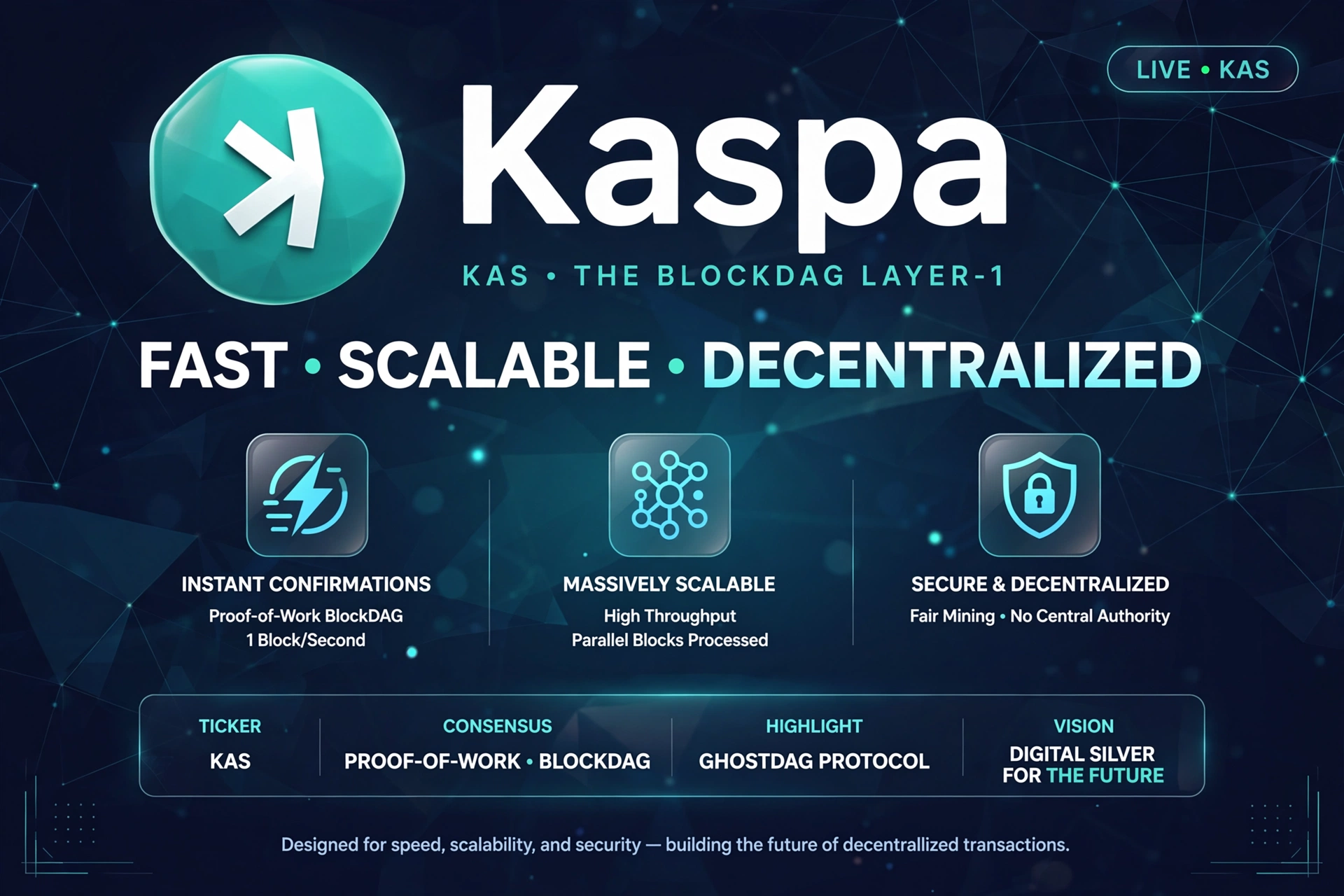

Kaspa (KAS) is an innovative Layer-1 cryptocurrency that aims to solve one of the most significant challenges in blockchain technology: achieving scalability without sacrificing decentralization and security. Built on a Proof-of-Work (PoW) consensus mechanism, Kaspa introduces a revolutionary architecture known as BlockDAG (Directed Acyclic Graph), powered by the GHOSTDAG protocol. Unlike traditional blockchains that process blocks sequentially, Kaspa allows multiple blocks to coexist and be confirmed simultaneously, enabling significantly faster transaction processing while maintaining the security principles of Bitcoin.
Since its fair launch in November 2021, Kaspa has gained considerable attention within the cryptocurrency industry due to its high-speed transactions, decentralized structure, and innovative consensus model. The project was designed to preserve the strengths of Bitcoin while eliminating many of the limitations associated with conventional blockchain networks.
What Is Kaspa (KAS)?
Kaspa is a decentralized, open-source cryptocurrency that utilizes Proof-of-Work security while implementing a BlockDAG architecture. The project was launched without a pre-mine, pre-sale, or insider allocations, making it one of the few truly community-driven blockchain networks in the crypto market.
The native cryptocurrency of the network is KAS, which is used for transaction fees, mining rewards, and ecosystem participation. Kaspa’s primary objective is to create a blockchain network capable of processing transactions at internet speed while maintaining strong security guarantees and decentralization.
According to CoinMarketCap and CoinGecko, Kaspa was designed as a scalable evolution of Bitcoin’s consensus mechanism, allowing the network to process parallel blocks rather than discarding them as orphan blocks. This approach significantly improves throughput and transaction confirmation times while preserving network integrity.
The Technology Behind Kaspa
BlockDAG Architecture
Traditional blockchains create blocks one after another in a linear chain. When multiple miners produce blocks simultaneously, only one block is accepted while the others become orphaned. This limitation reduces network efficiency and scalability.
Kaspa addresses this issue through its BlockDAG architecture. Instead of discarding parallel blocks, the network includes them in the ledger and orders them through consensus. This allows multiple blocks to be processed simultaneously, dramatically increasing throughput and reducing confirmation times.
GHOSTDAG Protocol
At the core of Kaspa’s technology lies the GHOSTDAG protocol, a generalization of Nakamoto Consensus. GHOSTDAG enables the network to maintain security while processing multiple blocks in parallel.
The protocol determines which blocks are honest and organizes them within the BlockDAG structure. This approach allows Kaspa to achieve high transaction speeds without compromising decentralization or security. Unlike many competing blockchain solutions, Kaspa does not rely on centralized validators or complex Proof-of-Stake systems.
Proof-of-Work Security
Kaspa remains committed to the Proof-of-Work model that made Bitcoin successful. The network uses the kHeavyHash mining algorithm, which secures the blockchain while promoting fair participation among miners.
By combining BlockDAG with Proof-of-Work, Kaspa attempts to solve the blockchain trilemma: balancing scalability, decentralization, and security simultaneously.
Key Features of Kaspa
Extremely Fast Transactions
One of Kaspa’s most notable features is transaction speed. The network currently processes approximately 10 blocks per second following the Crescendo upgrade, with long-term goals of reaching 100 blocks per second. This is significantly faster than Bitcoin’s average block time of ten minutes.
Instant Confirmation Visibility
Transactions become visible almost immediately after being submitted. Users experience near-instant transaction acknowledgment, making Kaspa suitable for payments, decentralized finance applications, and real-time financial systems.
Fair Launch Model
Kaspa launched without venture capital allocations, private sales, or pre-mined tokens. Every KAS coin entered circulation through mining, ensuring a more equitable distribution compared to many modern cryptocurrencies.
Community Governance
The project operates as an open-source community-driven initiative. There is no central authority controlling the network, and development is supported by contributors from around the world.
Kaspa Tokenomics
Kaspa follows a unique monetary policy designed to create predictable and decreasing token emissions over time. The network has a maximum supply of approximately 28.7 billion KAS tokens.
Instead of traditional halving events like Bitcoin, Kaspa uses a gradual emission reduction model known as the “chromatic phase.” Under this system, rewards decrease smoothly every month, resulting in a more predictable reduction in supply growth.
As of recent market data, over 27 billion KAS tokens are already in circulation, representing the majority of the maximum supply.
Kaspa’s Advantages Over Traditional Blockchains
Kaspa introduces several advantages compared to older blockchain networks:
- Faster transaction processing through parallel block creation.
- Improved scalability without sacrificing security.
- Lower transaction confirmation times.
- Strong decentralization through Proof-of-Work mining.
- Community-led development and governance.
- Fair token distribution with no insider allocations.
These characteristics make Kaspa an attractive option for users seeking a balance between Bitcoin-level security and modern blockchain performance.
Real-World Use Cases
Digital Payments
Kaspa’s fast confirmation times make it suitable for everyday payments. Merchants and consumers can receive transaction confirmation within seconds rather than waiting several minutes.
Decentralized Finance (DeFi)
The network’s scalability supports decentralized applications and financial services that require rapid transaction execution and low latency. Recent developments have expanded Kaspa’s potential within the DeFi ecosystem.
Smart Contract Development
Kaspa is evolving beyond a payment-focused blockchain. Recent upgrades have introduced greater programmability, creating opportunities for smart contracts, decentralized applications, and tokenized ecosystems.
Global Financial Infrastructure
The project’s long-term vision is to become a global transaction-sequencing layer capable of supporting both traditional finance and decentralized financial markets.
Market Performance
Kaspa has experienced substantial growth since its launch. The cryptocurrency reached an all-time high of approximately $0.207 in July 2024, demonstrating significant investor interest and market adoption. While market conditions fluctuate, Kaspa continues to maintain a strong presence among leading blockchain projects.
The project’s growing ecosystem, expanding exchange listings, and active community contribute to its ongoing visibility in the cryptocurrency sector.
Challenges and Risks
Despite its technological strengths, Kaspa faces several challenges:
- Competition from established Layer-1 networks.
- Dependence on continued ecosystem growth.
- Cryptocurrency market volatility.
- Regulatory uncertainty affecting the broader crypto industry.
- The need for wider developer adoption and application development.
Like all cryptocurrencies, investors should conduct thorough research before making financial decisions.
Conclusion
Kaspa (KAS) represents one of the most innovative developments in the Proof-of-Work blockchain sector. Through its BlockDAG architecture and GHOSTDAG consensus protocol, the project successfully addresses many of the scalability limitations that have historically constrained blockchain networks.
By combining fast transaction speeds, strong security, decentralization, and a fair-launch model, Kaspa positions itself as a compelling alternative to traditional blockchain platforms. As the ecosystem continues to expand and new technological upgrades are implemented, Kaspa may play an increasingly important role in the future of decentralized finance, digital payments, and blockchain infrastructure.
