


XRP is one of the most recognized digital assets in the cryptocurrency market, frequently appearing in headlines related to price movements, regulatory developments, and global payment innovations. Despite its popularity, many investors and newcomers still have questions about what it actually is and how it works.
At its core, XRP is the native digital asset of the Ledger (XRPL), a public blockchain launched in 2012. The Ledger was designed to facilitate fast, secure, and low-cost financial transactions, particularly for cross-border payments and currency transfers. Unlike many cryptocurrencies, XRP was not mined. Instead, its entire supply was created when the network launched, making it fundamentally different from cryptocurrencies such as Bitcoin.
This guide explores the origins of XRP, how the XRP Ledger functions, its tokenomics, real-world applications, and the key features that distinguish it from other blockchain networks.
What Is XRP?
XRP is a cryptocurrency that operates on the XRP Ledger, a decentralized blockchain network designed for efficient value transfer. As a digital asset, XRP enables users to send and receive payments globally without relying on traditional banking intermediaries.
The XRP Ledger was developed between 2011 and 2012 by Jed McCaleb, Arthur Britto, and David Schwartz. Unlike Bitcoin, which gradually releases new coins through mining, XRP’s entire maximum supply of 100 billion tokens was created at launch. This means no additional can ever be minted.
A significant aspect of XRP’s history is its relationship with Ripple, the technology company that develops payment solutions using blockchain technology. At launch, 80 billion were allocated to Ripple to support ecosystem development, while the remaining 20 billion were distributed among the founders. This initial distribution continues to influence discussions about supply and market dynamics today.
What Is the XRP Ledger?
The XRP Ledger (XRPL) is the blockchain infrastructure that powers XRP transactions. While the terms XRP Ledger are often used interchangeably, they represent different components of the ecosystem.
The XRP Ledger is a decentralized, open-source blockchain designed to record and validate financial transactions. It serves as a distributed database that maintains a secure and transparent record of network activity.
Like other blockchains, the XRP Ledger organizes transaction data into cryptographically secured records. Each record is linked to the previous one, creating an immutable chain of information. This structure helps maintain data integrity and prevents unauthorized modifications. The XRPL was specifically designed to prioritize speed, efficiency, and scalability, making it suitable for payment-focused applications.
How Does XRP Ledger Consensus Work?
One of the most unique aspects of the XRP Ledger is its consensus mechanism. Unlike Bitcoin, which relies on Proof-of-Work mining, XRPL uses a Federated Consensus Protocol.
The network is maintained by independent validators that review and verify proposed transactions. Validators communicate with one another and compare transaction sets during each consensus round. When approximately 80% of trusted validators agree on a transaction set, a new ledger version is finalized and added to the blockchain.
This consensus process typically completes within a few seconds, enabling near-instant settlement of transactions. The absence of mining also significantly reduces energy consumption compared to traditional Proof-of-Work blockchains.
The XRP Ledger is capable of processing approximately 1,500 transactions per second, making it one of the fastest public blockchain networks currently in operation.
XRP Token Supply and Tokenomics
XRP has a fixed maximum supply of 100 billion tokens. Since the entire supply was created at launch, no additional XRP can enter circulation through mining or staking rewards.
As of August 2026, XRP’s supply metrics include:
- Maximum Supply: 100 billion XRP
- Total Supply: Approximately 99.98 billion XRP
- Circulating Supply: Approximately 62.74 billion XRP
- Market Capitalization: Approximately $93.18 billion
- Fully Diluted Valuation (FDV): Approximately $148.5 billion
Understanding the distinction between market capitalization and fully diluted valuation is important. Market capitalization is calculated using only the XRP currently in circulation, while FDV assumes that all existing XRP tokens are available in the market.
In 2017, Ripple placed 55 billion XRP into escrow accounts to create a predictable release schedule. This escrow system was designed to provide transparency regarding future supply and reduce concerns about sudden large-scale token releases.
Although XRP releases occur according to predetermined conditions, investors should regularly review Ripple’s official updates for the most current escrow information.
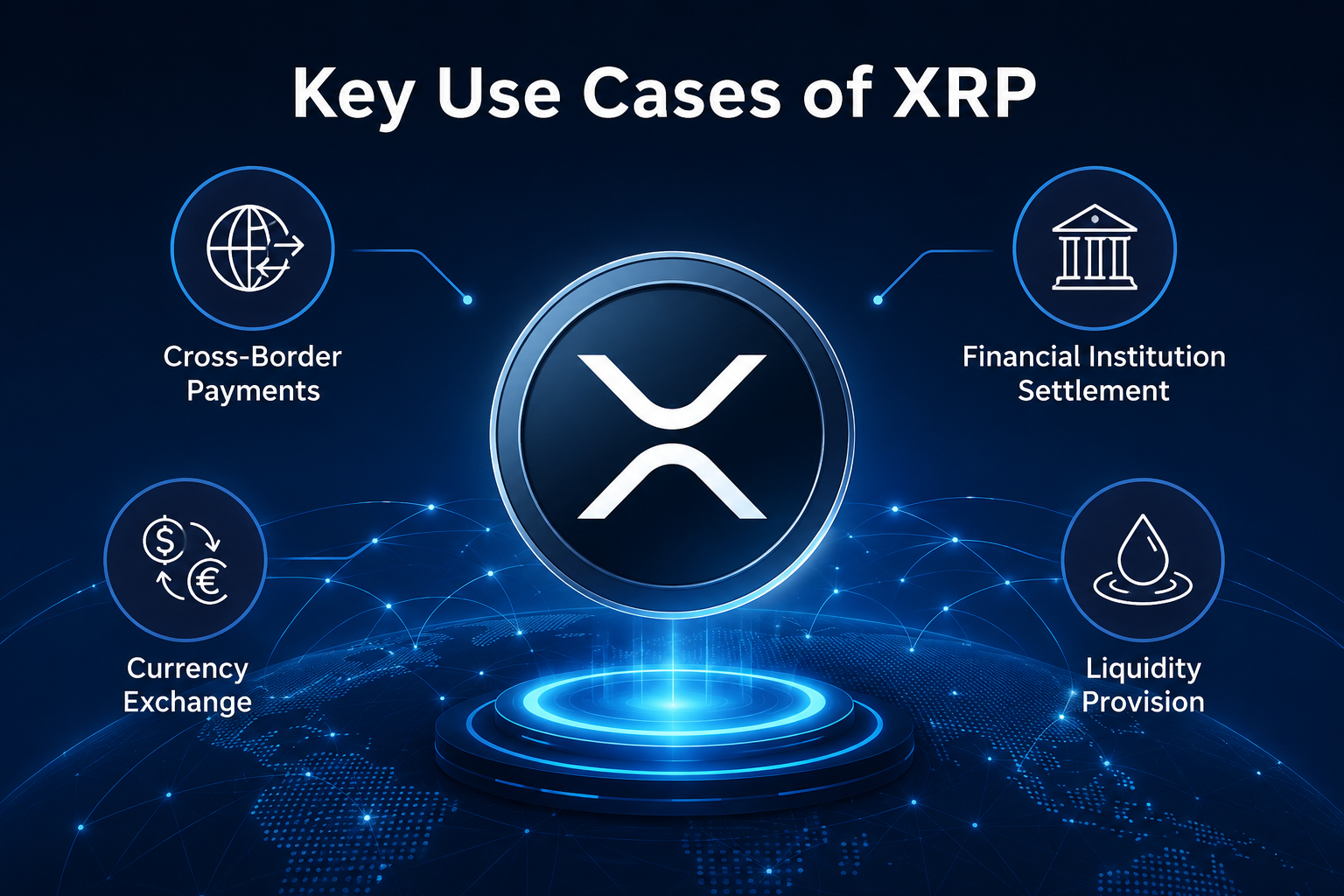
Key Use Cases of XRP
Cross-Border Payments
One of XRP’s primary use cases is facilitating international money transfers. Traditional cross-border payments often involve multiple intermediaries, resulting in higher fees and slower settlement times.
XRP can serve as a bridge asset between different currencies, allowing value to move efficiently across financial systems. This capability has made XRP particularly attractive for payment-focused applications.
Fast and Low-Cost Transactions
The XRP Ledger is known for its low transaction costs. Typical transaction fees are often fractions of a cent, making microtransactions and global transfers economically viable.
Combined with settlement times of just a few seconds, XRP offers a practical solution for transferring value quickly across borders.
Tokenization
The XRP Ledger supports the creation and management of custom digital assets. Businesses and developers can issue tokens representing real-world assets, stablecoins, loyalty points, or other digital instruments directly on the blockchain.
Decentralized Finance (DeFi)
XRPL includes a built-in decentralized exchange (DEX), allowing users to trade assets directly on the network without relying on centralized intermediaries. This functionality supports various decentralized finance applications and liquidity solutions.
Automated and AI-Driven Transactions
Emerging developments within the XRP ecosystem are exploring automated transaction systems and AI-powered payment mechanisms. While still evolving, these technologies could expand the utility of XRPL in future financial applications.
What Makes XRP Different from Other Cryptocurrencies?
No Mining Process
Unlike Bitcoin, XRP does not require mining. Since all tokens already exist, the network avoids the significant energy consumption associated with Proof-of-Work systems.
High-Speed Settlement
XRP transactions typically settle within three to five seconds. This speed significantly exceeds that of many traditional payment networks and blockchain systems.
Low Transaction Fees
The XRP Ledger is designed to keep transaction costs extremely low, making it suitable for both large-scale transfers and smaller everyday transactions.
Unique Consensus Mechanism
Rather than relying on miners or stakers, XRPL uses a network of validators that reach agreement through consensus. This approach enhances efficiency while maintaining network security.
Enterprise and Payment Focus
While many cryptocurrencies focus on decentralized applications or smart contracts, XRP was specifically developed to improve global payments and financial infrastructure.
Ripple and XRP: The Relationship
A common source of confusion involves the distinction between Ripple and XRP.
Ripple is a technology company that develops blockchain-based payment solutions for financial institutions and businesses. XRP, on the other hand, is the native cryptocurrency of the XRP Ledger.
Although Ripple utilizes XRP in some of its payment products, the XRP Ledger itself operates independently as an open-source decentralized blockchain. XRP can continue functioning regardless of Ripple’s business operations.
However, Ripple’s substantial XRP holdings and ecosystem involvement mean the company remains an influential participant within the broader XRP ecosystem.
Where Can You Buy and Store XRP?
XRP is available on numerous cryptocurrency exchanges around the world and consistently ranks among the most actively traded digital assets.
Investors can purchase XRP through supported centralized exchanges and store it in compatible cryptocurrency wallets that support the XRP Ledger.
Wallet options include:
- Hardware wallets for long-term storage
- Mobile wallets for everyday use
- Desktop wallets
- Exchange wallets for active trading
Before selecting a wallet, users should evaluate security features, accessibility, and compatibility with the XRP Ledger.
Advantages and Challenges of XRP
Advantages
XRP offers several benefits that contribute to its popularity:
- Fast transaction settlement
- Extremely low transaction fees
- Energy-efficient consensus model
- Strong focus on cross-border payments
- Established blockchain infrastructure
- Built-in decentralized exchange functionality
Challenges
Like all cryptocurrencies, XRP also faces certain challenges:
- Regulatory uncertainty in some jurisdictions
- Ongoing discussions regarding token distribution
- Market volatility
- Competition from other payment-focused blockchain networks
- Dependence on broader cryptocurrency market trends
Investors should consider both opportunities and risks when evaluating XRP as part of their research process.
The Future of XRP and the XRP Ledger
The long-term success of XRP will depend on several factors, including technological innovation, regulatory developments, adoption by financial institutions, and broader cryptocurrency market conditions.
The XRP Ledger continues to evolve through community-driven improvements and ecosystem expansion. Areas such as tokenization, decentralized finance, stablecoin integration, and automated payment systems may contribute to future growth.
While XRP’s technical advantages are well documented, predicting future adoption levels or market performance remains speculative. Investors should rely on official sources, current market data, and independent research when assessing XRP’s prospects.
Conclusion
XRP is the native digital asset of the Ledger, a blockchain specifically designed for fast, efficient, and low-cost value transfer. Since its launch in 2012, the network has distinguished itself through its unique consensus mechanism, rapid transaction settlement, and focus on global payments.
Unlike cryptocurrencies that rely on mining, XRP operates with a fixed supply of 100 billion tokens, all of which were created at launch. The XRP Ledger’s combination of scalability, low fees, and built-in financial features has helped it maintain a prominent position within the cryptocurrency industry.
Disclaimer
This article is intended for informational and educational purposes only and should not be considered financial, investment, or legal advice. Cryptocurrency markets are highly volatile, and readers should conduct their own research and consult qualified financial professionals before making investment decisions.
