

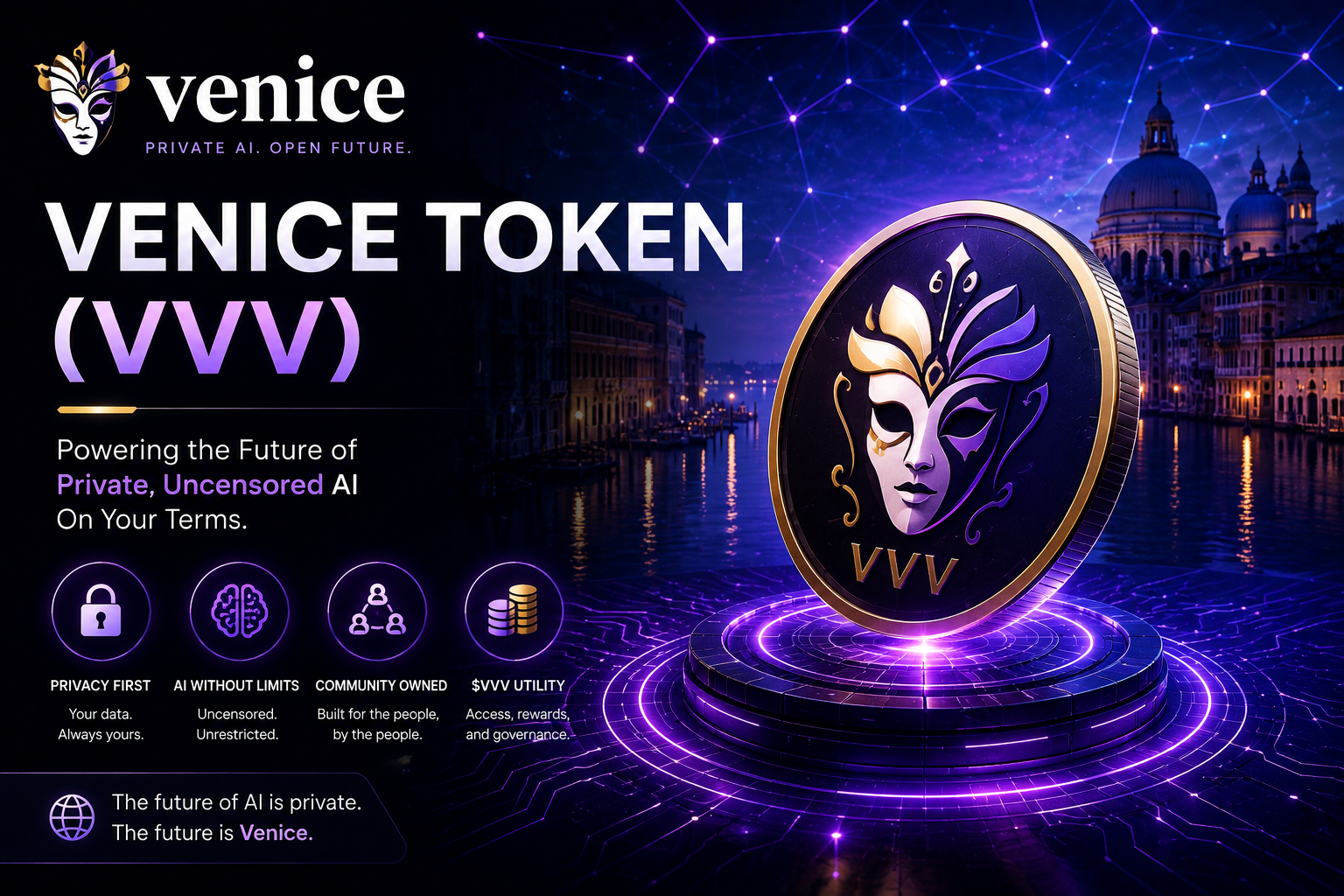

The cryptocurrency industry continues to evolve beyond traditional financial applications, with artificial intelligence (AI) emerging as one of the most promising sectors. Among the projects leading this convergence of AI and blockchain technology is the Venice Token (VVV), the native utility token of the Venice AI ecosystem. Venice AI aims to provide private, uncensored, and decentralized AI services while leveraging blockchain technology to create a sustainable economic model for AI computation.
Venice Token (VVV) serves as the foundation of a programmable AI economy, enabling users, developers, and AI agents to access AI inference resources through staking mechanisms rather than traditional pay-per-use pricing models. This innovative approach distinguishes Venice from many existing AI platforms and positions it as a unique participant in the rapidly growing AI crypto sector.
What Is Venice Token (VVV)?
Venice Token (VVV) is the native utility token of the Venice AI platform, a privacy-focused artificial intelligence ecosystem founded to provide unrestricted access to AI models and services. Unlike many centralized AI platforms that collect user data and impose content restrictions, Venice AI emphasizes user privacy and decentralized ownership.
The primary purpose of VVV is to create a tokenized AI infrastructure where holders can gain access to AI computing power through staking. Instead of paying for every API request, users stake VVV tokens to obtain ongoing access to AI services, making AI resources more predictable and economically efficient.
Built on the Base blockchain ecosystem, VVV acts as the economic layer for Venice’s AI marketplace, supporting transactions, staking rewards, ecosystem incentives, and access to tokenized AI computation.
How Venice AI Works
Venice AI combines blockchain technology with advanced AI services, including text generation, image creation, and code generation. The platform uses open-source AI models while prioritizing privacy and decentralization.
The core innovation lies in its staking-based access model. Users stake VVV tokens and receive staking rewards while simultaneously gaining access to AI resources. This creates a dual-benefit ecosystem where token holders can participate in network growth while utilizing AI services.
The Venice ecosystem also introduced DIEM, a tokenized compute unit that represents AI inference capacity. Users can lock staked VVV (sVVV) to mint DIEM tokens, which can then be used for AI API credits or traded within the ecosystem. This model transforms AI computation into a transferable digital asset.
Key Features of Venice Token
1. AI Infrastructure Ownership
VVV allows users to own a share of Venice’s AI infrastructure rather than simply paying for access. This ownership model aligns incentives between platform users and token holders.
2. Staking Rewards
Token holders can stake VVV and earn yield while contributing to the network’s security and utility. Staking serves as one of the primary drivers of token demand.
3. Tokenized Compute Economy
Through the DIEM system, Venice converts AI inference capacity into a blockchain-based asset. This allows users to transfer, trade, or monetize AI resources.
4. Privacy-Focused AI Access
Venice AI positions itself as an alternative to traditional AI services by emphasizing user privacy and minimizing centralized control over AI interactions.
5. AI Agent Integration
The platform is specifically designed to support AI agents, automated applications, and developers who require scalable AI inference resources.
Venice Tokenomics
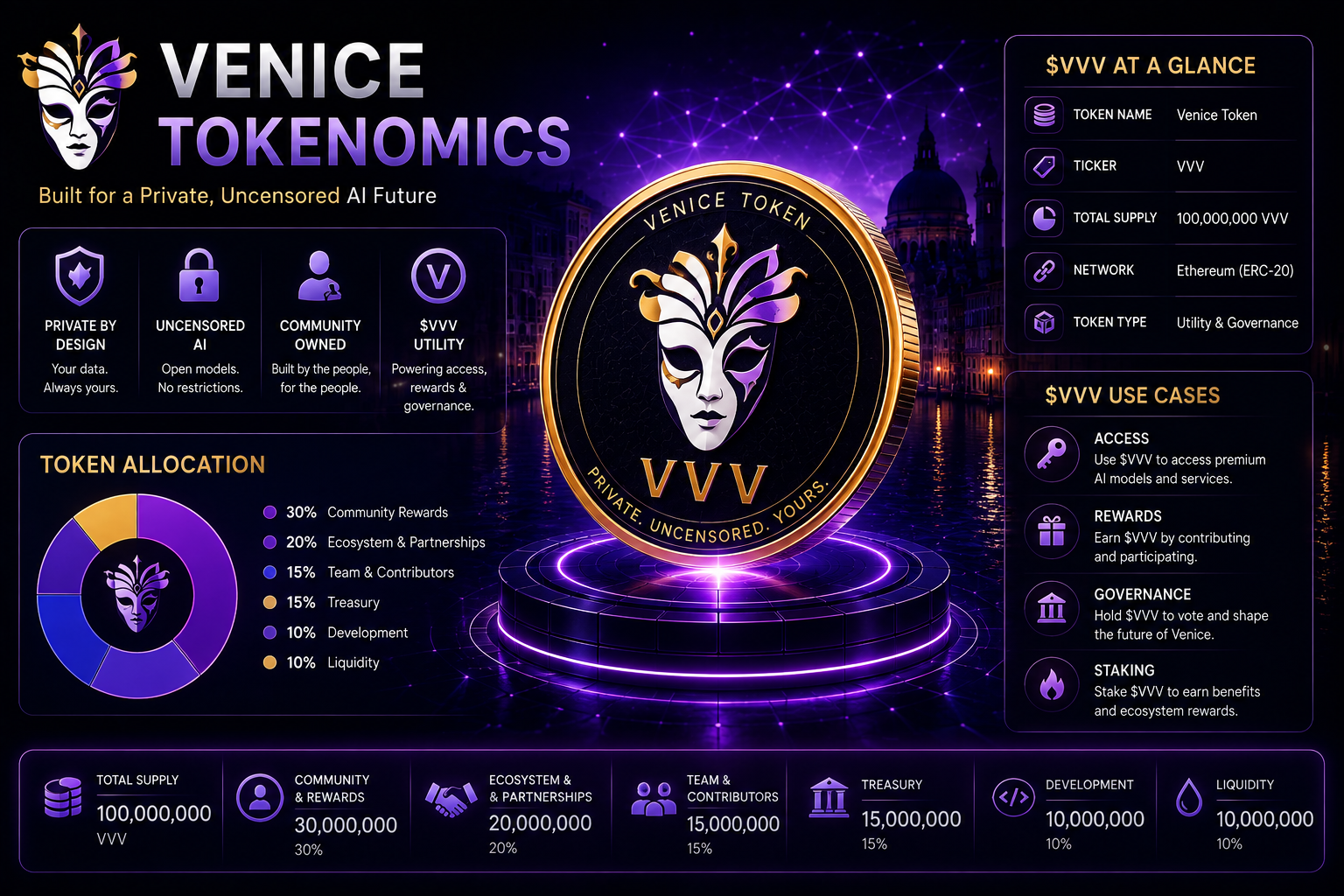
The Venice Token ecosystem is built around a carefully structured tokenomics model designed to balance growth, adoption, and sustainability.
Initial Supply
The initial supply of VVV was set at 100 million tokens. The allocation includes:
- 50% allocated to Venice users and the AI community through airdrops.
- 35% allocated for Venice AI development and growth initiatives.
- 10% reserved for ecosystem incentives.
- 5% allocated for liquidity provision.
Emissions Model
The network originally implemented annual token emissions to reward participants. Over time, emission rates have been adjusted to improve sustainability and align incentives with platform growth. Recent updates indicate reduced emissions compared to the original launch model.
Utility-Driven Demand
Unlike purely speculative cryptocurrencies, VVV’s demand is linked to practical utility. Users stake tokens to gain AI access, mint DIEM, and participate in the broader AI economy. This creates an economic relationship between platform usage and token demand.
Use Cases of VVV Token
AI API Access
Developers can utilize VVV to gain access to Venice AI’s API services for building AI-powered applications.
AI Agent Operations
Autonomous AI agents can leverage VVV and DIEM to obtain ongoing inference capacity without relying on traditional subscription models.
Staking and Passive Rewards
Investors can stake VVV tokens and earn rewards while supporting the ecosystem.
Ecosystem Participation
Token holders can participate in ecosystem growth, incentive programs, and future governance developments.
Advantages of Venice Token
One of the strongest advantages of Venice Token is its direct connection to AI infrastructure. As demand for AI services increases globally, projects that tokenize AI resources may benefit from growing adoption.
The platform also offers a unique economic model that reduces reliance on traditional subscription fees. By staking VVV, users effectively gain ownership-like access to AI services rather than continuously paying for usage.
Additionally, Venice’s privacy-focused approach appeals to users concerned about data collection and censorship on mainstream AI platforms.
Potential Risks
Like all cryptocurrencies, VVV carries investment risks. The project operates in the highly competitive AI and blockchain sectors, where rapid innovation and competition can impact adoption.
The success of Venice Token depends largely on the continued growth of the Venice AI platform, user adoption, and demand for AI services. Regulatory developments affecting AI or cryptocurrencies may also influence the project’s future.
Investors should conduct thorough research and understand market risks before making investment decisions.
Future Outlook
The future of Venice Token appears closely tied to the expansion of decentralized AI infrastructure. As AI applications become increasingly integrated into business operations, software development, content creation, and automation, demand for scalable AI resources may continue to rise.
Venice’s vision of a programmable AI economy, combined with tokenized AI computation through DIEM, positions the project within one of the fastest-growing segments of the blockchain industry. Continued ecosystem development, strategic partnerships, and growing AI adoption could strengthen the utility and relevance of VVV in the coming years.
Conclusion
Venice Token (VVV) represents an innovative intersection of artificial intelligence and blockchain technology. By creating a tokenized economy for AI computation, Venice AI seeks to transform how users access and pay for AI services. Through staking, tokenized compute units, and privacy-focused infrastructure, VVV offers a unique value proposition compared to traditional AI platforms and many competing AI cryptocurrencies.
As decentralized AI continues to evolve, Venice Token stands out for its practical utility, staking-based access model, and focus on empowering users with greater control over AI resources. While risks remain, VVV has established itself as a noteworthy project within the emerging AI crypto landscape.

1 Comment
Pingback: Crypto Airdrops September 2026: Top 5 Opportunities to Watch