


Flare (FLR) is an innovative Layer-1 blockchain designed to solve one of the biggest challenges in the cryptocurrency industry: secure and decentralized access to data from other blockchains and real-world sources. Unlike traditional networks that rely heavily on third-party oracles and bridges, Flare integrates data acquisition protocols directly into its blockchain architecture. This approach enables developers to build decentralized applications (dApps) with reliable access to external data while maintaining high levels of security and decentralization.
What Is Flare (FLR)?
Flare is an Ethereum Virtual Machine (EVM)-compatible Layer-1 blockchain that focuses on interoperability and data accessibility. The network was created to provide decentralized applications with secure access to information from multiple blockchain ecosystems and internet-based data sources. By integrating data protocols into the blockchain itself, Flare aims to eliminate many of the vulnerabilities associated with traditional bridges and external oracle systems.
The native cryptocurrency of the network is FLR, which is used for transaction fees, governance, staking, network security, and participation in Flare’s data protocols. Developers can deploy Ethereum-compatible smart contracts on Flare with minimal modifications, making it easy to migrate existing decentralized applications.
The Vision Behind Flare
The primary objective of Flare is to make blockchain technology more useful by enabling decentralized access to high-integrity data. Most blockchains operate in isolation, limiting their ability to interact with external networks and real-world information. Flare addresses this issue by creating a secure infrastructure where data can flow seamlessly between different ecosystems.
This vision expands the utility of blockchain technology beyond simple transactions and smart contracts, supporting use cases such as decentralized finance (DeFi), gaming, insurance, tokenized assets, and cross-chain applications.
Key Features of Flare Network
1. State Connector
The State Connector is one of Flare’s most important innovations. It enables decentralized verification of events and transactions that occur on external blockchains. Instead of relying on centralized intermediaries, the State Connector uses decentralized attestation providers to validate information securely.
Key benefits include:
- Trustless verification of external blockchain events
- Enhanced cross-chain interoperability
- Reduced dependence on vulnerable bridge systems
- Improved security for decentralized applications
The State Connector allows Flare smart contracts to access and verify data from other blockchain networks without sacrificing decentralization.
2. Flare Time Series Oracle (FTSO)
The Flare Time Series Oracle (FTSO) is a decentralized oracle system built directly into the network. It provides accurate price feeds and other time-series data needed by DeFi protocols and applications. Unlike many blockchain ecosystems that rely on external oracle providers, Flare includes this functionality at the protocol level.
Advantages of FTSO include:
- Decentralized data feeds
- Multiple independent data providers
- High reliability and transparency
- Support for DeFi and cross-chain applications
Token holders can delegate their wrapped FLR (WFLR) tokens to FTSO providers and earn rewards while helping secure the network.
3. FAssets
FAssets enable assets from blockchains without native smart contract functionality, such as Bitcoin, XRP, and Dogecoin, to participate in decentralized finance on Flare. The system creates trustless, over-collateralized representations of these assets that can be used within the Flare ecosystem.
Benefits of FAssets include:
- Access to DeFi opportunities for non-smart-contract assets
- Trustless bridging mechanisms
- Over-collateralized security model
- Enhanced liquidity across blockchain ecosystems
Through FAssets, users can unlock additional utility for assets that were previously limited in decentralized applications.
How Flare Works
Flare combines EVM compatibility with native interoperability protocols. This unique architecture enables smart contracts to access verified blockchain and off-chain data directly through network-level infrastructure. Developers can build applications that interact with multiple blockchain ecosystems while benefiting from Flare’s security model.
The network uses a Proof-of-Stake (PoS) consensus mechanism, known as Flare Stake, to maintain security and network integrity. Validators, FTSO providers, and State Connector participants contribute to the ecosystem while earning rewards.
FLR Token Utility
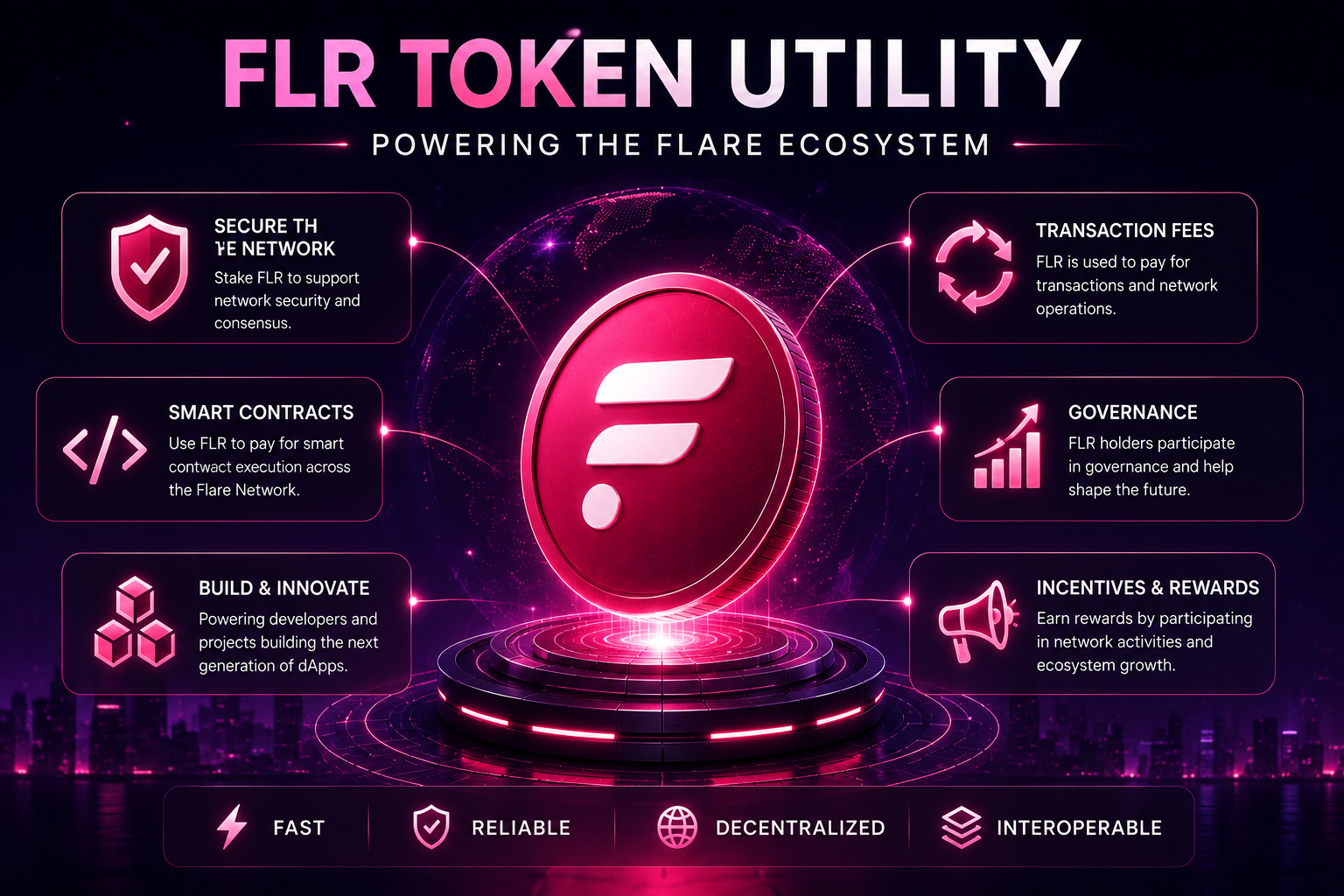
The FLR token serves several important functions within the ecosystem:
Transaction Fees
FLR is used to pay gas fees for transactions and smart contract execution on the network.
Governance
Token holders can participate in governance decisions and influence the future direction of the protocol.
Staking and Delegation
Users can stake or delegate wrapped FLR to FTSO providers, helping secure decentralized data delivery while earning rewards.
Collateral for FAssets
FLR serves as collateral within the FAssets system, supporting trustless representations of external blockchain assets.
Flare Ecosystem Growth
Flare has attracted developers, infrastructure providers, and decentralized applications seeking secure interoperability solutions. The ecosystem includes DeFi platforms, data providers, wallets, and blockchain infrastructure partners. The network supports more than 60 chain integrations and continues expanding its ecosystem of applications and services.
Its compatibility with Ethereum tools allows developers to leverage familiar frameworks while gaining access to Flare’s native data capabilities.
Advantages of Flare Network
Several factors distinguish Flare from competing blockchain networks:
- Native data acquisition protocols
- Strong interoperability capabilities
- EVM compatibility
- Trustless cross-chain communication
- Decentralized oracle infrastructure
- Support for Bitcoin, XRP, Dogecoin, and other assets through FAssets
- Scalable architecture for data-intensive applications
These features position Flare as a specialized blockchain focused on solving real-world interoperability challenges.
Challenges and Risks
Like all blockchain projects, Flare faces several challenges:
- Competition from established interoperability solutions
- Dependence on ecosystem growth and developer adoption
- Market volatility affecting FLR token performance
- Regulatory uncertainty in the cryptocurrency industry
The success of Flare will depend on continued adoption, technological development, and the expansion of its application ecosystem.
Future Potential of Flare
Flare’s long-term potential lies in its ability to become a leading infrastructure layer for decentralized data access and blockchain interoperability. As demand for cross-chain applications increases, networks capable of securely connecting different ecosystems may play a critical role in the future of Web3.
The ongoing development of FAssets, expansion of chain integrations, and growth of the DeFi ecosystem could significantly enhance the network’s utility over time. Flare’s focus on providing data as a public good may also attract developers building the next generation of decentralized applications.
Conclusion
Flare (FLR) is a next-generation Layer-1 blockchain designed to bring decentralized data access and interoperability to the broader blockchain ecosystem. Through its innovative technologies—including the State Connector, Flare Time Series Oracle (FTSO), and FAssets—Flare enables secure communication between blockchains while providing developers with reliable access to external data. Its EVM compatibility, strong infrastructure, and focus on interoperability make it a promising project within the rapidly evolving Web3 landscape. While challenges remain, Flare’s unique architecture positions it as an important player in the future of decentralized finance and cross-chain innovation.
