



Binance BTC USDT futures is Binance’s flagship USDⓈ-M margined perpetual contract. Binance, the world’s largest crypto exchange by volume, offers it as a way to trade the value of Bitcoin without buying spot BTC. Instead of owning the asset, you are trading a derivative that mirrors its price.
The appeal is straightforward. You can go long when you think Bitcoin will rise, or short when you think it will fall, and your P&L settles directly in USDT. Because it is perpetual, there is no settlement date looming. You stay in the trade as long as you meet margin requirements. The funding rate is what keeps this perpetual honest, pulling its price back toward spot every few hours.
For many traders, BTCUSDT is the starting point because it is the most liquid futures pair on Binance. Spreads are razor-thin, slippage is minimal even on larger orders, and the order book is deep around the clock.
BTCUSDT Perpetual vs. Quarterly Futures on Binance
Perpetual and quarterly sound similar, but they behave differently. The perpetual has no expiry. Quarterly futures expire on the last Friday of each quarter. If you are a day trader or swing trader, you almost always want perpetual. You don’t have to worry about rolling your position into a new contract.
Quarterly contracts trade differently because they have a basis – a premium or discount to spot that reflects time until expiry. They don’t use funding rates. Perpetuals do. For most people searching for binance btc usdt futures, they mean the perpetual, not the quarterly.
USDⓈ-M vs. COIN-M: Which BTC Futures Contract Should You Use?
This is where a lot of confusion starts. USDⓈ-M means you use USDT as collateral. You deposit USDT, you margin with USDT, you earn or lose USDT. If you think in dollars, this is the simpler path.
COIN-M, like the BTCUSD perpetual, is margined in Bitcoin itself. You would use it if you are a long-term BTC holder and want to hedge. Say you hold 1 BTC and want protection against a drop without selling it. You could short BTCUSD COIN-M. Your collateral stays in BTC and your profit comes back in BTC. Unless you have a specific reason to stay in Bitcoin as collateral, stick with BTCUSDT USDⓈ-M. It has better liquidity, it is easier to calculate, and it matches how most portfolios are tracked.
Binance BTCUSDT Futures Contract Specifications
The specs for BTCUSDT on Binance are built for precision and for safety. The contract size is fractional, so you don’t need to trade a whole Bitcoin. The minimum price movement, or tick size, is usually $0.10, though Binance can adjust it during extreme volatility to keep the order book orderly.
Leverage is where you need to pay attention. Yes, Binance advertises up to 125x. That headline number only applies to small positions, typically under $50,000 in notional value. Binance runs a tiered margin system. As your position gets larger, your maximum allowed leverage automatically comes down. A $250,000 position might only allow 50x. A $1 million position even less. This is not there to limit you; it is there to stop a single large liquidation from cascading through the market.
Two prices matter more than the chart itself. Last Price is what actually traded. Mark Price is Binance’s fair price, calculated from the spot index plus a moving average of the funding basis. Binance uses Mark Price to trigger liquidations, not Last Price. That detail saves you from getting wicked out by a sudden, thin futures spike that never happened on spot.
Funding Rate, Funding Interval and Settlement Mechanism
Funding is not a fee to Binance. It is a payment exchanged directly between traders. Every 8 hours, at 00:00, 08:00, and 16:00 UTC, the system checks if perpetual is trading above or below spot.
If funding is positive, say 0.01%, longs are paying shorts because perpetual is priced above spot. If it is negative, shorts pay longs. For scalpers who are in and out in minutes, funding is almost irrelevant. For anyone holding for days, it becomes your cost of carry. In a strong bull market where funding stays positive for weeks, those three daily payments can quietly eat a large chunk of your profit. Smart traders check the live funding history for BTCUSDT on Binance before committing to a swing long, and they avoid opening big positions a minute before the funding timestamp if the rate is sky-high.
Maintenance Margin and Liquidation Logic
Liquidation happens when your margin ratio drops below the maintenance requirement. In isolated margin, only the USDT you assigned to that specific trade is at risk. Your other positions are safe. In cross margin, Binance will pull from your entire USDⓈ-M wallet to try to keep the position alive.
Binance doesn’t immediately wipe you out at 100% margin ratio. The liquidation engine first tries to reduce risk. But if losses keep mounting, it closes the position at market. You also pay a small fee into the insurance fund when this happens. That is why a planned stop-loss is always cheaper than a forced liquidation.
Binance BTC USDT Futures Fees Explained
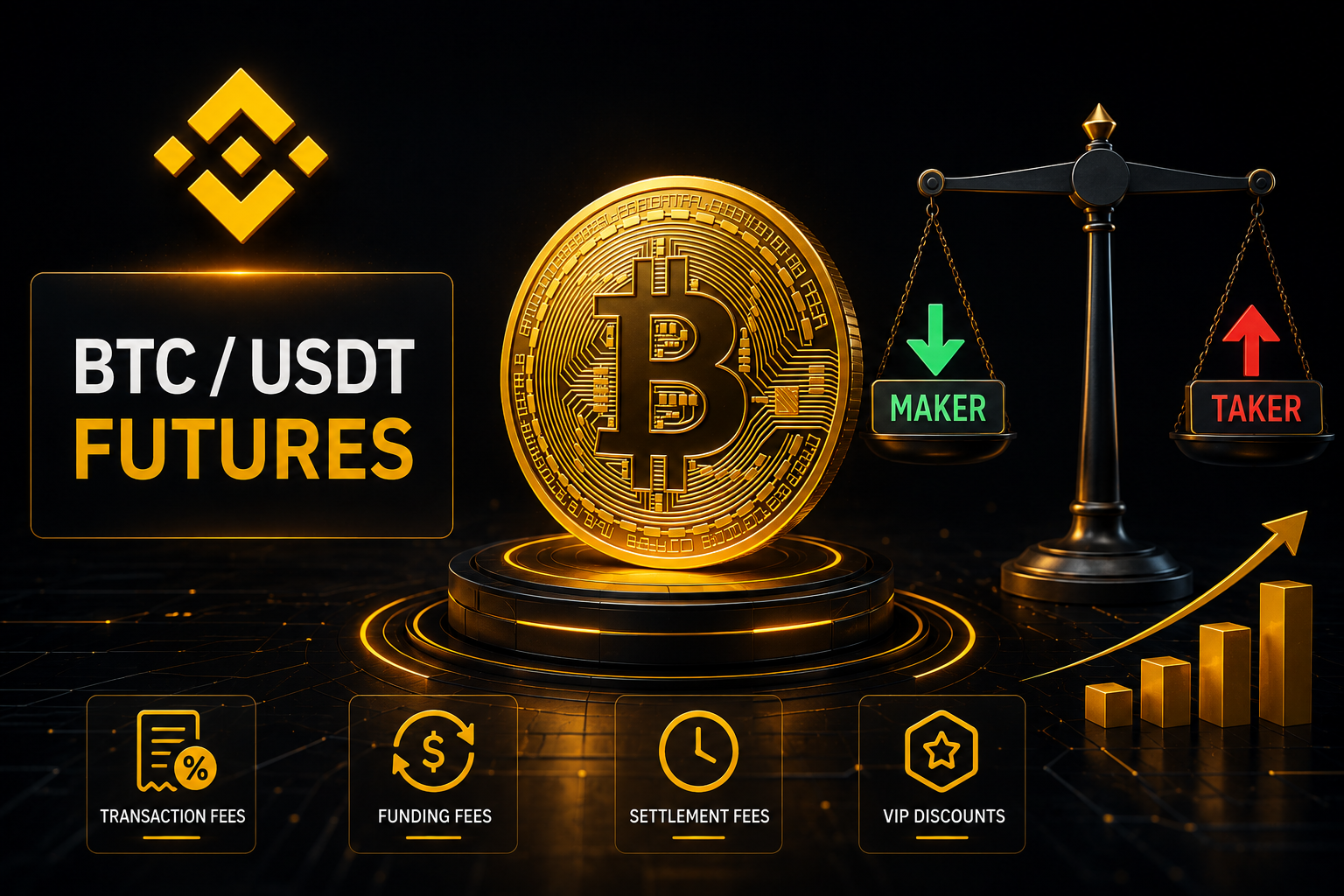
Fees on Binance BTC USDT futures come down to two things: what you pay to trade, and what you pay to hold.
Trading fees start at around 0.02% maker and 0.04% taker for a regular USDⓈ-M user. If you place a limit order that sits on the book and adds liquidity, you are a maker and you pay less. If you hit the book with a market order that takes liquidity, you pay the taker rate. Holding BNB and turning on the BNB discount, or simply trading more volume to move up VIP tiers, brings those numbers down.
Funding fees are separate. The math is simple: Funding Rate x Position Notional Value. Hold a $10,000 long when funding is 0.01%, you pay $1 to shorts. Hold the same short, you earn $1. Many new traders see a deduction in their wallet after 08:00 UTC and think Binance charged them. It didn’t. That dollar moved to the other side of the trade. It is the core mechanic that keeps perpetuals pegged to spot.
How to Trade BTC USDT Futures on Binance [Step-by-Step]
Trading BTC USDT futures on Binance is less about clicking buttons and more about setup. You first need to activate futures by signing the risk disclosure. Then move funds. You cannot trade futures with USDT sitting in your spot wallet. You need to do an internal transfer to your USDⓈ-M futures wallet. It is instant and free.
Step 1: Enable Futures and Transfer Funds to Your USDⓈ-M Wallet
Open futures for the first time and Binance will ask you to complete a short quiz. Once enabled, go to Wallet, hit Transfer, and move USDT from Spot to USDⓈ-M Futures. Get in the habit of only transferring what you intend to risk.
Step 2: Set Margin Mode [Isolated vs Cross] and Adjust Leverage
On the BTCUSDT chart, you will see Isolated and Cross at the top. If you are still learning, choose Isolated. It quarantines risk to one trade. A bad trade will hurt, but it will not drain your whole futures wallet.
Next to it is the leverage slider. Here is how experienced traders think about it: don’t pick leverage to chase profit. Pick your stop-loss distance first based on your strategy, decide how much of your account you are willing to lose on that idea, and let leverage be the math that makes it fit. That mindset alone keeps you out of 125x gambles.
Step 3: Choose Your Order Type and Open a Long or Short Position
Market orders get you in immediately but cost you taker fees and slippage. Limit orders let you name your price and save on fees. For most situations, limit orders for entries work best, while stop-market orders work best for exits.
Binance lets you attach Take Profit and Stop Loss to your entry order. Do it right there. Define your exit before you are emotionally in the trade. It is the easiest way to stay disciplined.
Step 4: Manage Your Position and Set Risk Controls
Once you are in, the Positions tab becomes your cockpit. You will see entry price, Mark Price, liquidation price, margin ratio, and unrealized PnL. You can scale out, move your take-profit, or close fully. One rule good traders never break: never move a stop-loss further away just because price is getting close. If the thesis is wrong, get out. Adding margin to a losing isolated position to avoid a stop is how small losses become account-ending losses.
How to Calculate Profit, Loss and Liquidation Price
You cannot trade futures safely if you cannot do the basic math.
For PnL, the formula is straightforward because everything is in USDT. If you are long, it is (Exit Price – Entry Price) x Quantity. If you are short, it is (Entry Price – Exit Price) x Quantity. Go long 0.1 BTC at $65,000 and sell at $66,000, your gross profit is ($66,000 – $65,000) x 0.1 = $100. Then subtract trading fees and any funding you paid or received.
Liquidation is about distance. For a long, your liquidation price sits below your entry. For a short, it sits above. Roughly, for a long: Entry Price x [1 – (1/Leverage) + Maintenance Margin Rate]. The exact number includes fees and your precise margin. The practical lesson matters more than the exact decimal: at 100x, a 0.8% move against you is enough to liquidate. At 10x, you can absorb roughly a 9% move. Lower leverage doesn’t just reduce risk; it gives your idea room to be volatile, which Bitcoin always is.
Risks of Trading Binance BTC USDT Futures
Leverage is the obvious risk, but not the only one. A 3% move on Bitcoin is normal. At 50x, that is a 150% move on your margin. Without a stop, that move erases you in minutes.
Funding is the quiet risk. When everyone is euphoric and long, funding can spike to 0.1% or even 0.3% per 8-hour window. Holding a long through that means you are paying a premium to the market just to stay in. On the flip side, being short when funding is extremely positive can be lucrative, but you are fighting momentum.
Then there is behavioral risk. Futures are open 24/7 and they are fast. The biggest account killer is not one bad trade, it is overtrading right after a loss to win it back. Binance has built-in safeguards like Price Protection that prevents your stop from filling at a ridiculous wick, and you can set a cooling-off period on your account. Use them. The best futures traders I know obsess less about win rate and more about how small they keep their losers.
Is Binance BTC USDT Futures Right for You?
Binance BTC USDT futures make sense if you already understand spot and want more flexibility. It is ideal if you want to short Bitcoin without borrowing, hedge your spot holdings, or trade with less capital up front. The reason it dominates is not marketing. It is depth. Orders fill instantly, even for size, and the trading engine tends to stay up when volatility explodes.
It is not for someone who has never placed a spot trade, or for anyone who sees leverage as a shortcut. If that is you, spend time on the Binance Futures testnet. Trade with 2x or 3x isolated, with an amount you are fully comfortable losing. Consider your first month as learning the interface and your own reactions, not as a way to make profit quickly.
