


Pyth Network (PYTH) is one of the world’s leading decentralized oracle networks that delivers real-time financial market data to blockchain applications. Unlike traditional oracle services that rely on third-party aggregators, Pyth receives first-party data directly from leading exchanges, trading firms, and financial institutions. This approach improves data accuracy, transparency, and reliability for decentralized finance (DeFi) applications.
Launched to solve the blockchain oracle problem, Pyth enables smart contracts to access live prices for cryptocurrencies, stocks, commodities, foreign exchange (Forex), ETFs, and other financial assets across dozens of blockchain ecosystems.
How Pyth Network Works
Pyth Network uses a unique pull oracle model, where applications request the latest price only when required instead of continuously pushing updates on-chain. This design significantly reduces blockchain transaction costs while maintaining high-speed data accuracy.
The network receives pricing information directly from more than 120 financial institutions, including major cryptocurrency exchanges, market makers, and traditional financial firms. These data providers publish their own prices to Pyth, where the protocol aggregates and verifies the information before making it available to decentralized applications.
Key Features of Pyth Network
1. First-Party Market Data
Unlike many oracle networks that collect information from multiple external APIs, Pyth sources market data directly from institutions responsible for creating that data.
This greatly reduces the chances of inaccurate pricing.
2. Extremely Fast Price Updates
Pyth updates its price feeds approximately every 400 milliseconds, making it one of the fastest oracle networks in the blockchain industry.
Fast updates are essential for:
- Decentralized exchanges
- Lending protocols
- Perpetual futures
- Synthetic assets
- Options trading
3. Multi-Asset Coverage
Pyth currently supports over 380 price feeds, including:
- Cryptocurrencies
- Stocks
- Commodities
- Foreign Exchange
- ETFs
- Precious Metals
This broad coverage makes it suitable for nearly every DeFi application requiring accurate financial data.
4. Cross-Chain Compatibility
Pyth operates across more than 40 blockchain networks, including:
- Ethereum
- Solana
- Arbitrum
- Optimism
- Base
- BNB Chain
- zkSync Era
Developers can integrate identical price feeds across supported chains without additional complexity.
What Is the PYTH Token?
The PYTH token is the native cryptocurrency of the Pyth Network ecosystem.
Its primary uses include:
- Governance voting
- Network participation
- Incentive alignment
- Ecosystem growth
Token holders can participate in governance decisions regarding protocol upgrades and network development.
Pyth Network Tokenomics
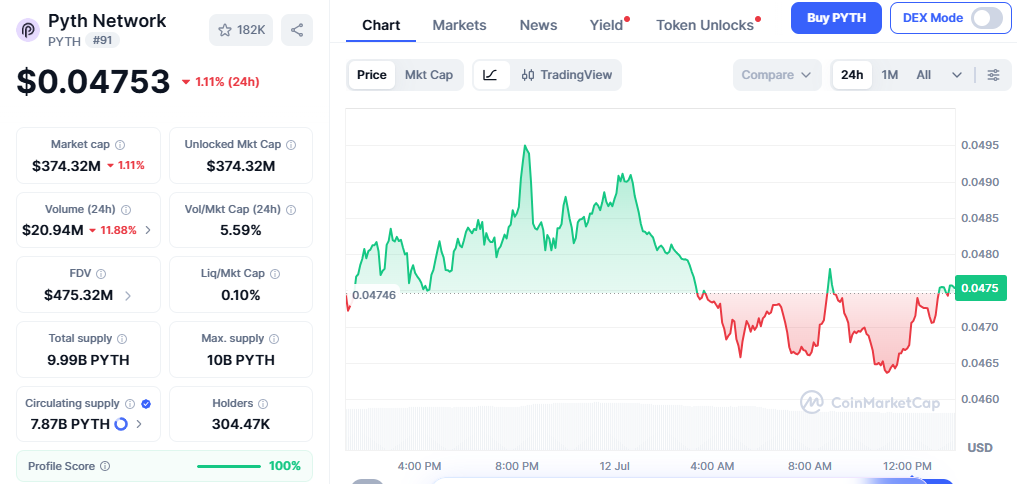
According to available market data:
- Maximum Supply: 10 Billion PYTH
- Circulating Supply: Approximately 7.87 Billion PYTH
- Market Capitalization: Around $370 Million (varies with market conditions)
- Fully Diluted Valuation (FDV): Approximately $470 Million
These values change frequently based on market activity.
Why Developers Prefer Pyth Network
Many blockchain developers choose Pyth because it provides:
- High-frequency pricing
- Reliable institutional data
- Permissionless integration
- Low latency
- Multi-chain deployment
- Transparent confidence intervals for every price feed
Confidence intervals allow applications to estimate market uncertainty alongside the reported price, improving risk management for financial protocols.
Pyth Network Use Cases
Pyth supports numerous blockchain applications, including:
Decentralized Exchanges (DEXs)
Accurate pricing enables secure token swaps and perpetual futures trading.
Lending Platforms
Real-time collateral valuation helps reduce liquidation risks.
Synthetic Assets
Price feeds ensure synthetic tokens accurately mirror real-world assets.
Prediction Markets
Reliable market data improves betting accuracy and settlement.
Yield Farming
Protocols use trusted prices to calculate rewards and collateral values.
Advantages of Pyth Network
Several characteristics distinguish Pyth from traditional oracle providers:
Institutional Data Sources
Prices originate directly from financial institutions instead of external aggregators.
High-Speed Updates
Near real-time updates reduce stale pricing.
Cross-Chain Support
One integration works across dozens of blockchain ecosystems.
Large Ecosystem
Hundreds of decentralized applications already utilize Pyth price feeds.
Transparent Architecture
Open-source development and publicly available documentation increase trust.
Potential Risks
Although Pyth offers many advantages, investors should also consider potential risks:
- Cryptocurrency market volatility
- Token unlock schedules
- Competition from other oracle networks
- Regulatory uncertainty
- DeFi adoption cycles
Like any crypto asset, PYTH’s market value can fluctuate significantly over short periods.
Pyth Network Price Performance
Since its public launch, PYTH has experienced considerable price volatility, consistent with many newly introduced crypto assets.
Market data platforms indicate:
- Previous all-time high above $1
- Significant correction during broader crypto market downturns
- Ongoing recovery attempts alongside overall market sentiment
Current prices and rankings change continuously depending on trading activity.
Pyth Network Price Prediction
While no forecast is guaranteed, analysts generally evaluate PYTH based on:
- Oracle network adoption
- DeFi market growth
- Institutional partnerships
- Developer activity
- Token supply dynamics
- Overall cryptocurrency market trends
If blockchain adoption continues expanding, demand for reliable oracle infrastructure could strengthen Pyth’s long-term position. However, price performance remains subject to market conditions and investor sentiment.
Competitive Position
Pyth has become one of the fastest-growing oracle solutions because of its emphasis on first-party financial data and scalable cross-chain infrastructure. Its growing ecosystem of publishers and supported blockchains positions it as an important infrastructure layer for decentralized finance. Continued expansion of supported applications and institutional data providers may further strengthen its role within the broader blockchain ecosystem.
Conclusion
Pyth Network has established itself as one of the most innovative oracle networks in the cryptocurrency industry. By sourcing market data directly from leading financial institutions and delivering ultra-fast, low-latency price feeds across more than 40 blockchains, it addresses one of the most critical infrastructure challenges in decentralized finance.
The PYTH token supports governance and ecosystem participation while the protocol continues expanding its network of data publishers and supported applications. Although investors should remain aware of market volatility and competitive risks, Pyth’s technology, institutional partnerships, and growing adoption make it a project worth monitoring in the evolving blockchain ecosystem.
