


Bitcoin has transformed the way people think about money, payments, and financial freedom. Since its launch in 2009 has grown from an experimental technology into one of the most valuable financial assets in the world. Today, millions of people use for investing, saving, transferring funds, and exploring the future of digital finance.
As the world becomes increasingly digital, traditional financial systems are evolving alongside innovative technologies. Bitcoin stands at the center of this revolution, offering a decentralized alternative to government-issued currencies. In 2026, Bitcoin continues to attract investors, businesses, institutions, and everyday users who want greater control over their finances.
This comprehensive beginner’s guide explains what Bitcoin is, how it works, why it is important, and how newcomers can safely get started. Whether you are curious about cryptocurrency, blockchain technology, digital assets, or decentralized finance, this guide will help you understand the fundamentals of Bitcoin in simple terms.
What Is Bitcoin?
Bitcoin is a digital currency that allows people to send and receive money over the internet without relying on banks or other financial institutions. Unlike traditional currencies such as the US Dollar, Euro, or Pakistani Rupee, Bitcoin exists entirely in digital form.
Bitcoin was created by an anonymous individual or group known as Satoshi Nakamoto. The primary goal was to create a peer-to-peer payment system that could operate independently of governments and central banks.
The Bitcoin network is powered by blockchain technology, a public digital ledger that records every transaction securely and transparently. This decentralized structure makes Bitcoin unique because no single organization controls the network.
Bitcoin is often referred to as digital gold because many investors view it as a store of value similar to precious metals. Its limited supply and growing global adoption have contributed to this comparison.
The History of Bitcoin
The concept of Bitcoin emerged during the global financial crisis of 2008. Satoshi Nakamoto published the Bitcoin whitepaper titled “Bitcoin: A Peer-to-Peer Electronic Cash System,” outlining a new form of digital money.
In January 2009, the first Bitcoin block, known as the Genesis Block, was mined. During its early years, Bitcoin had little monetary value and was primarily used by technology enthusiasts.
One of the most famous moments in Bitcoin history occurred in 2010 when a programmer paid 10,000 Bitcoins for two pizzas. Today, those Bitcoins would be worth millions of dollars.
Over the years, Bitcoin has experienced significant growth, attracting institutional investors, major corporations, and governments. By 2026, Bitcoin has become a mainstream financial asset recognized worldwide.
How Does Bitcoin Work?
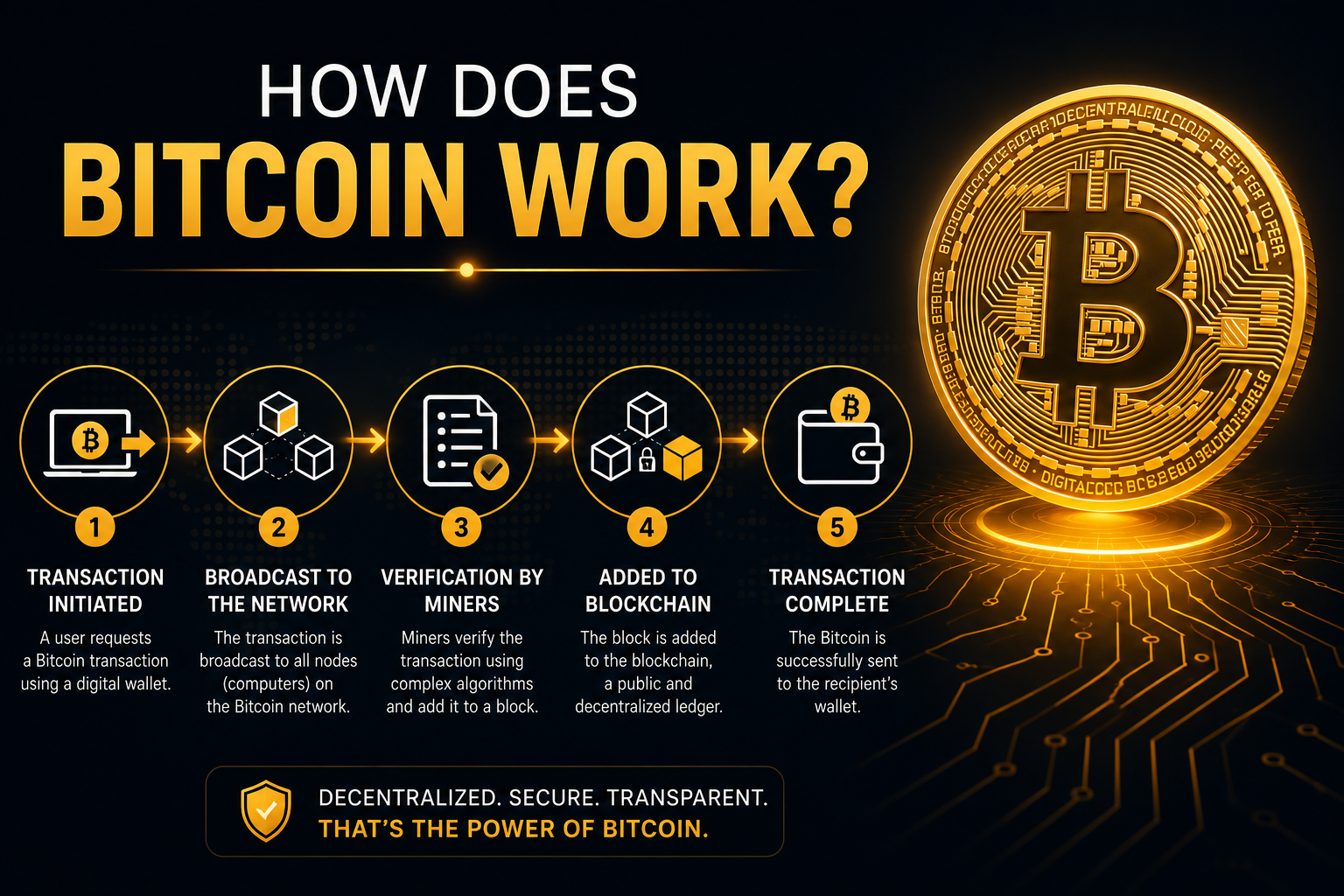
Bitcoin operates on a decentralized network of computers known as nodes. These computers work together to verify and record transactions without requiring a central authority.
When someone sends Bitcoin, the transaction is broadcast to the network. Miners then validate the transaction and add it to the blockchain. Once verified, the transaction becomes permanent and cannot easily be altered.
The blockchain functions as a digital ledger containing a complete history of all Bitcoin transactions. Because copies of the blockchain are stored across thousands of computers worldwide, the system remains highly secure and resistant to manipulation.
This innovative structure eliminates the need for intermediaries and enables direct peer-to-peer transfers between users.
Blockchain Technology
What Is a Blockchain?
A blockchain is a chain of digital blocks containing transaction data. Each block is connected to the previous one, creating an immutable record of information.
Every transaction made using Bitcoin is recorded on this blockchain. Since the ledger is publicly accessible, anyone can verify transactions while maintaining user privacy.
Why Is Blockchain Important?
Blockchain technology provides transparency, security, and decentralization. Because transactions are verified by multiple participants across the network, fraudulent activities become extremely difficult.
This technology has applications beyond Bitcoin, including smart contracts, supply chain management, healthcare systems, and financial services.
What Makes Bitcoin Valuable?
One of the most common questions beginners ask is why Bitcoin has value. Several factors contribute to Bitcoin’s worth.
First, Bitcoin has a fixed supply of only 21 million coins. This scarcity creates demand and helps protect against inflation.
Second, Bitcoin is decentralized, meaning no government or institution can control its issuance or monetary policy.
Third, global adoption continues to increase. Individuals, businesses, investment firms, and even governments are recognizing Bitcoin as a valuable financial asset.
Additionally, Bitcoin’s reputation as a store of value, combined with its growing acceptance, contributes significantly to its market value.
Bitcoin Mining Explained
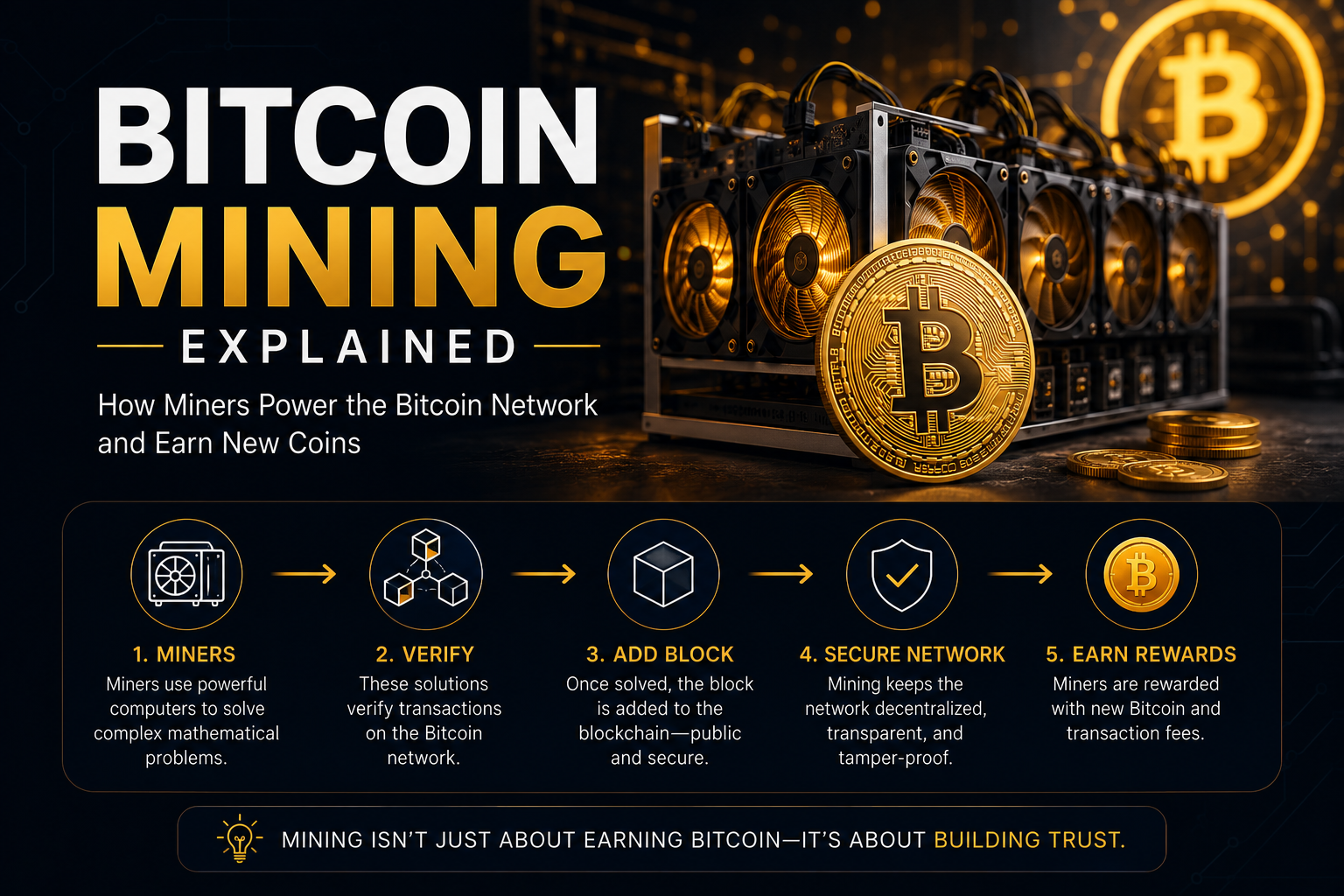
Bitcoin mining is the process through which new Bitcoins are created and transactions are verified.
Miners use powerful computers to solve complex mathematical problems. When a miner successfully solves a problem, they add a new block to the blockchain and receive a Bitcoin reward.
Mining serves two important purposes. It secures the network and introduces new Bitcoins into circulation.
Over time, mining rewards decrease through an event called the Bitcoin Halving. This mechanism helps maintain scarcity and supports Bitcoin’s long-term economic model.
Bitcoin Wallets: How to Store Bitcoin
To own Bitcoin, users need a Bitcoin wallet. A wallet is a digital tool that stores the private keys required to access and manage Bitcoin.
There are different types of wallets available for beginners and experienced users alike.
Hot Wallets
Hot wallets are connected to the internet and offer convenience for everyday transactions. Mobile apps and exchange wallets are common examples.
While easy to use, hot wallets can be more vulnerable to cyber threats if proper security measures are not followed.
Cold Wallets
Cold wallets store Bitcoin offline, making them significantly more secure. Hardware wallets are the most popular form of cold storage.
Many long-term investors prefer cold wallets because they reduce exposure to online attacks and hacking attempts.
Advantages of Bitcoin
Bitcoin offers numerous benefits that have contributed to its widespread popularity.
One major advantage is decentralization. Users can control their own funds without relying on traditional financial institutions.
Bitcoin also enables fast international transfers. Sending money across borders can be quicker and often less expensive than traditional banking methods.
Another benefit is transparency. Every transaction is recorded on the blockchain and can be independently verified.
Additionally, Bitcoin provides accessibility. Anyone with internet access can participate in the Bitcoin network regardless of geographic location.
Risks and Challenges of Bitcoin
Although Bitcoin offers many advantages, it is important for beginners to understand the associated risks.
The most notable challenge is price volatility. Bitcoin’s value can fluctuate significantly over short periods.
Regulatory uncertainty also remains a concern in some countries. Governments continue developing policies regarding cryptocurrency usage and taxation.
Security risks can arise if users fail to protect their private keys properly. Losing access to a wallet may result in permanent loss of funds.
Investors should always conduct research and adopt strong security practices before purchasing Bitcoin.
How to Buy Bitcoin in 2026
Buying has become easier than ever. Most beginners start by creating an account on a reputable cryptocurrency exchange.
After verifying their identity, users can deposit funds and purchase Bitcoin using traditional payment methods such as bank transfers or debit cards.
Once purchased, Bitcoin can remain on the exchange or be transferred to a personal wallet for enhanced security.
Before investing, beginners should understand market risks and only invest amounts they can afford to lose.
Bitcoin vs Traditional Money
Bitcoin differs significantly from traditional currencies.
Government-issued currencies are controlled by central banks, which can increase the money supply through monetary policies.
Bitcoin, however, has a fixed maximum supply of 21 million coins. This limited supply makes it resistant to inflation caused by excessive money creation.
Traditional banking systems operate during specific hours and often involve intermediaries. Bitcoin transactions can occur globally at any time without requiring third-party approval.
These characteristics have led many people to view Bitcoin as the future of digital finance.
The Future of Bitcoin in 2026 and Beyond
The future of remains one of the most discussed topics in the financial world. As adoption grows, continues evolving from a speculative asset into a recognized component of the global financial system.
Institutional investment, technological improvements, and increasing public awareness are strengthening Bitcoin’s position. More businesses are accepting cryptocurrency payments, while financial products built around Bitcoin continue expanding.
Experts believe Bitcoin may play an increasingly important role in digital payments, financial innovation, and decentralized finance (DeFi) over the coming years.
While challenges remain, Bitcoin’s long-term potential continues attracting investors and technology enthusiasts worldwide.
Conclusion
Bitcoin has revolutionized the concept of money by introducing a decentralized, transparent, and secure financial system. As the world’s first and most recognized cryptocurrency, Bitcoin has paved the way for a new era of digital finance.
Understanding how Bitcoin works, why it has value, and how to store it safely is essential for anyone interested in the future of money. While risks such as volatility and regulatory uncertainty exist, Bitcoin’s growing adoption and limited supply continue to make it one of the most influential financial innovations of the modern era.
